
Default cognitive modes under stress are predictable.
SCATR™ is a five-part decision architecture for maintaining decision reliability under stress.
The Default Mode Diagnostic identifies how decision patterns shift under stress.
SCATR provides the structured intervention used to correct these patterns and restore decision reliability.
It is a trainable decision system based on constraint, calibration, and feedback - not motivation or force.
If you have not yet completed the Default Mode Diagnostic:
Run Decision Mode Diagnostic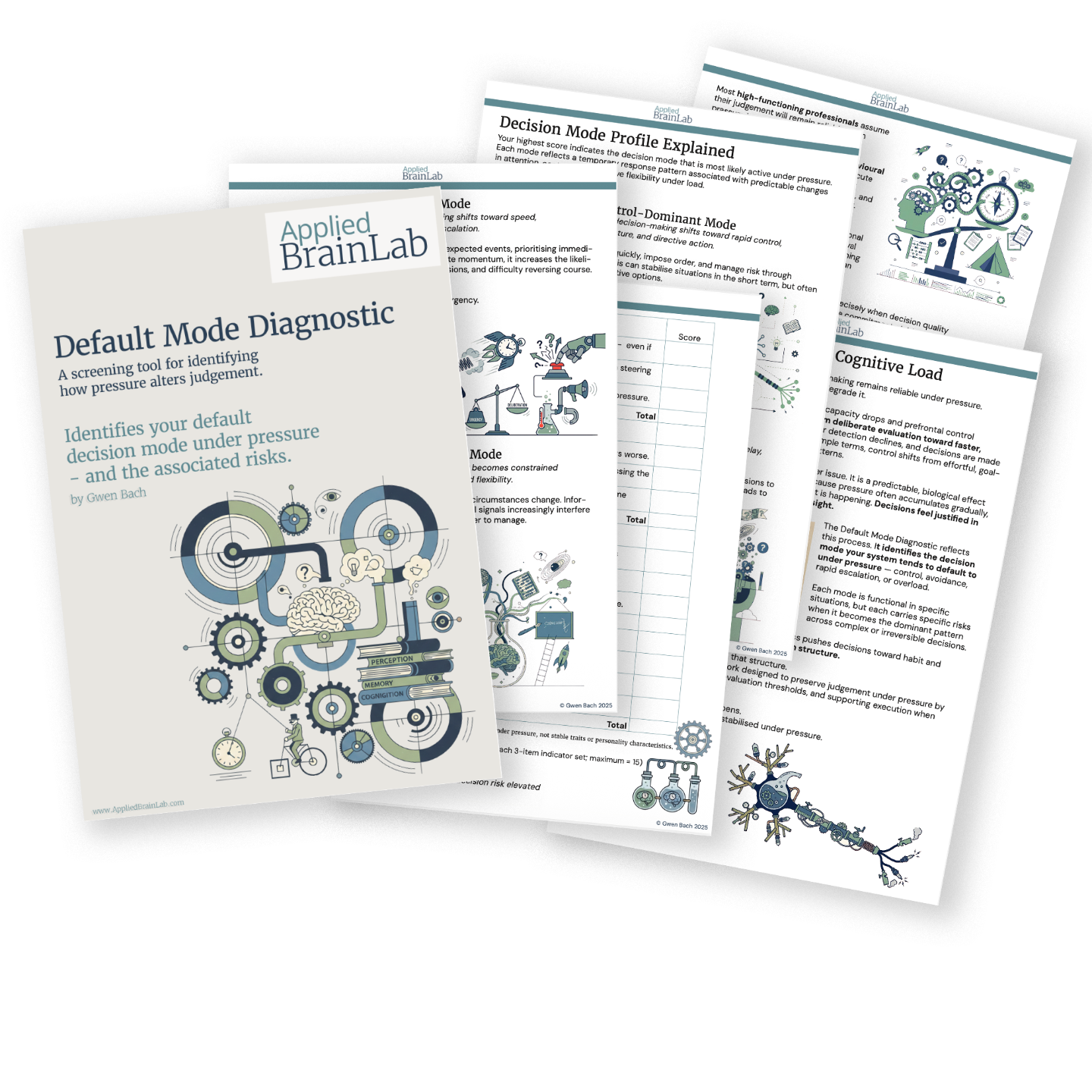
Pressure affects your brain biology:

Impaired executive function - Prefrontal Cortex is affected.
Shifts toward habitual processing – fast, automatic responses over deliberative control.

Compromised working memory - reduced ability to hold & process information.

Prioritises immediate action - hinders complex & uncertain decisions.
The SCATR Framework
gives you a structured, step-by-step approach to overcome these constraints.
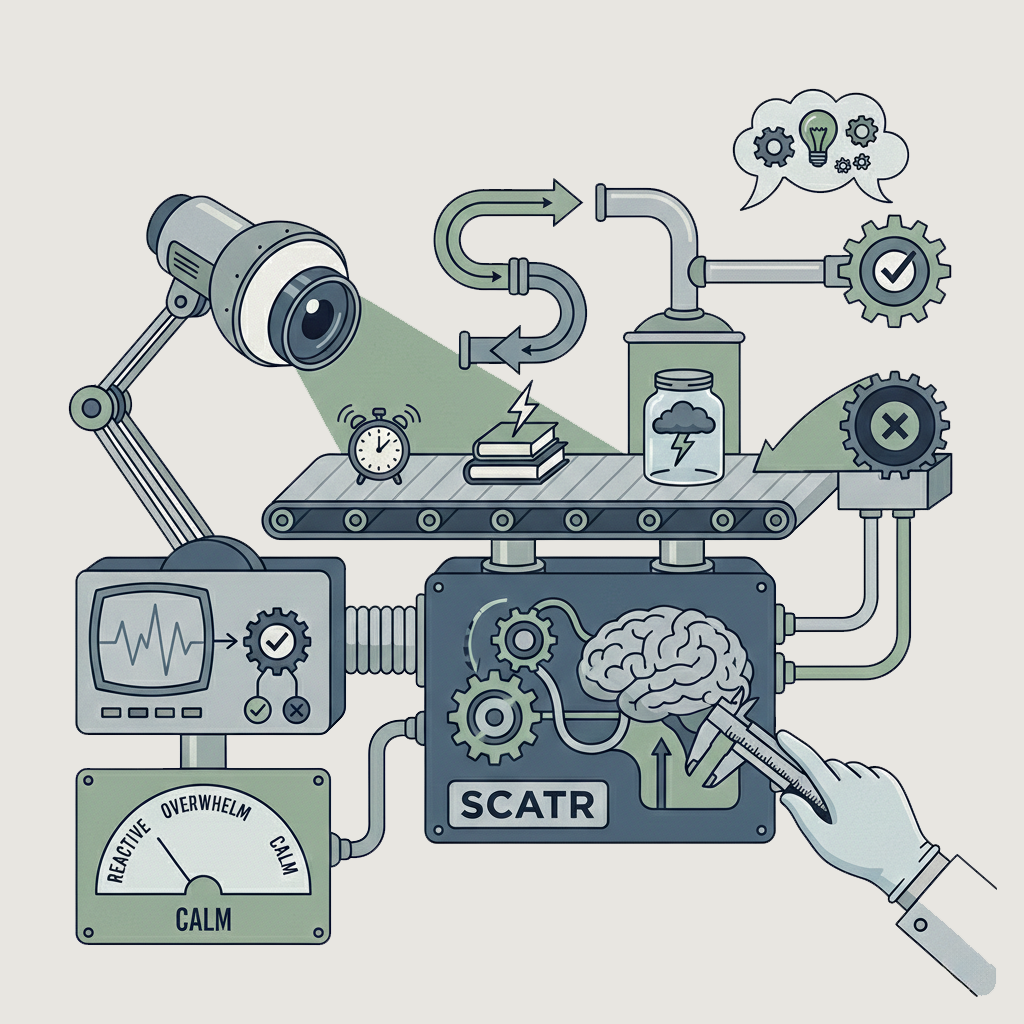
S — Scan Operating Conditions
Correction of decision reliability requires prior assessment of cognitive state.
SCATR scans operating conditions to identify overload, latent stressors, and early reliability changes.
Addresses: Reactive overwhelm, default pattern activation
Mechanism: Objective measurement replaces subjective estimation

C — Control Bandwidth
Attentional capacity is limited under stress.
SCATR constrains cognitive input to preserve attentional capacity for task-relevant processing.
Addresses: Distraction, cognitive overload
Mechanism: Reduces error risk by narrowing the decision space prior to evaluation
A — Anchor Relevant Variables
Decision reliability degrades when evaluation criteria remain implicit.
SCATR anchors relevant variables by externalising criteria, time constraints, and acceptable outcome ranges.
Addresses: Over-analysis, impulsive action, time distortion
Mechanism: Explicit constraints stabilise judgement under stress

T — Timing & Execution
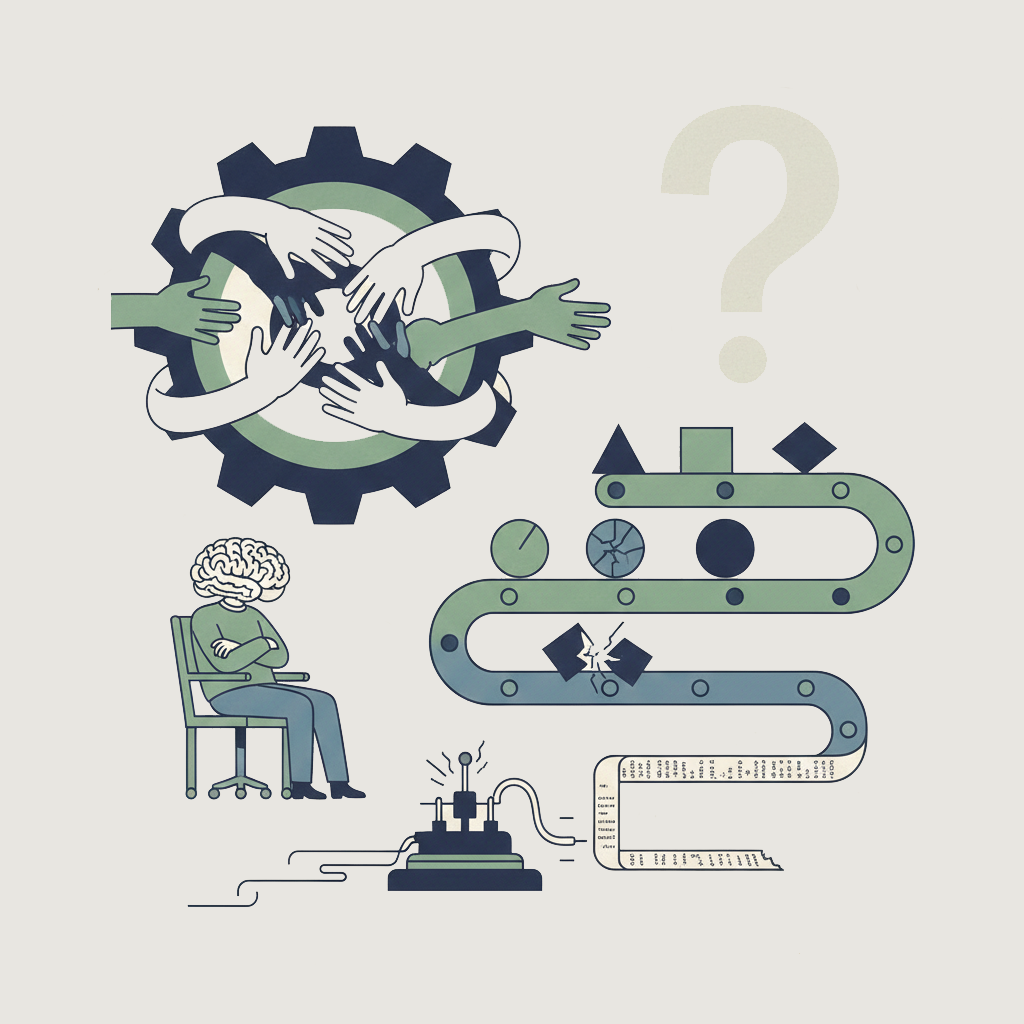
Decision reliability degrades when timing is miscalibrated.
SCATR aligns decisions with appropriate time horizons and translates them into executable actions under current constraints.
Addresses: Inaction, execution errors, time distortion
Mechanism: Execution is calibrated to temporal and cognitive constraints rather than driven by impulse
R — Reinforcement & Review
Decision reliability is not established through a single intervention.
SCATR maintains reliability over time through structured feedback, deliberate practice, and periodic review under varying conditions.
Addresses: Regression, second-guessing, performance drift
Mechanism: Feedback and review enable ongoing calibration and error correction

Next step
Request a 15–20 minute Clarity Call to assess fit and next steps.
No obligation. If SCATR is not appropriate, I’ll say so.
15–20 min. Short, useful conversation. Evidence-based.