
The Decision Is Only the Visible Part
May 12, 2026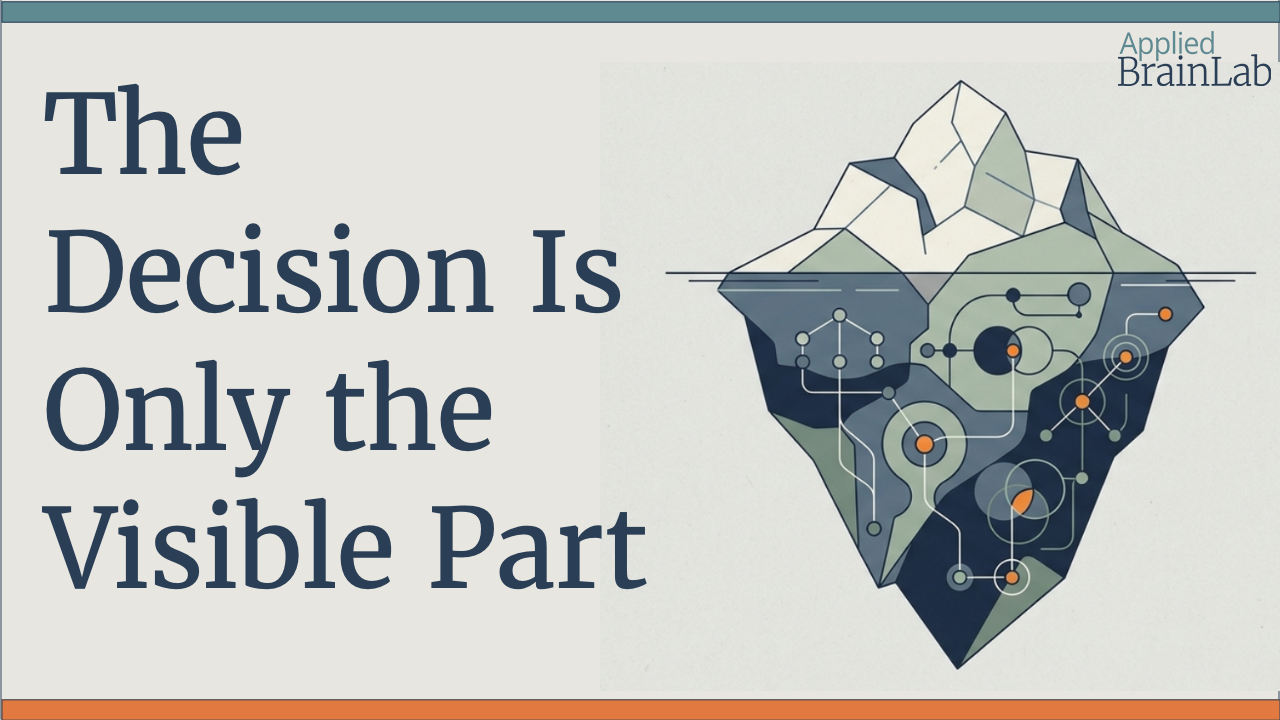
A few years ago, when my son was small, I seriously considered moving to London.
I was a single mother, working full time in Frankfurt, and doing most things alone. London sounded like relief. I had family there, and the idea of not being so isolated was immediately appealing. At first, moving seemed like a real option.
As I looked more closely, the picture changed. Similar jobs paid less than I expected, especially relative to London’s cost of living. The schools I visited did not feel right. I remember the high fences, the security, and the paint used to stop children climbing or leaning on walls.
Family support still mattered, but it was no longer the only variable. Income, daily stress, school environment, safety, and the kind of childhood I wanted for my son all became part of the decision.
What first looked like a decision about support became a decision about conditions.
I decided not to move.
From the outside, that decision could look simple: stay in Frankfurt rather than relocate to London. From the inside, it was not a single moment of choosing. It was a gradual change in what the decision was actually about.
That is how many real decisions work.
They do not begin with a neat list of options. They begin with a situation that has to be understood.
A Decision Is Rarely Just a Choice
In research, a decision is often defined as selecting one option, action, or response from several possibilities (Chick et al., 2012).
That definition is useful, but real life is usually messier.
Before we choose, the brain has to work out what kind of situation we are dealing with. It has to decide what matters, what can be ignored, which risks are serious, and which options are realistic.
In professional life, this happens constantly.
A leader does not simply approve a project. They interpret the problem, weigh the available information, estimate consequences, consider constraints, and commit to a direction.
A team does not simply choose a strategy. They bring assumptions, prior experience, emotional signals, time pressure, uncertainty, and incomplete information into the discussion.
Decision-making includes much more than the final act of choosing. It involves framing the situation, evaluating evidence, weighing possible outcomes, and committing to action (Fox et al., 2013; Schall, 2013).
The final decision is the part we can see.
Most of the work happens before that.
The Decision Surface
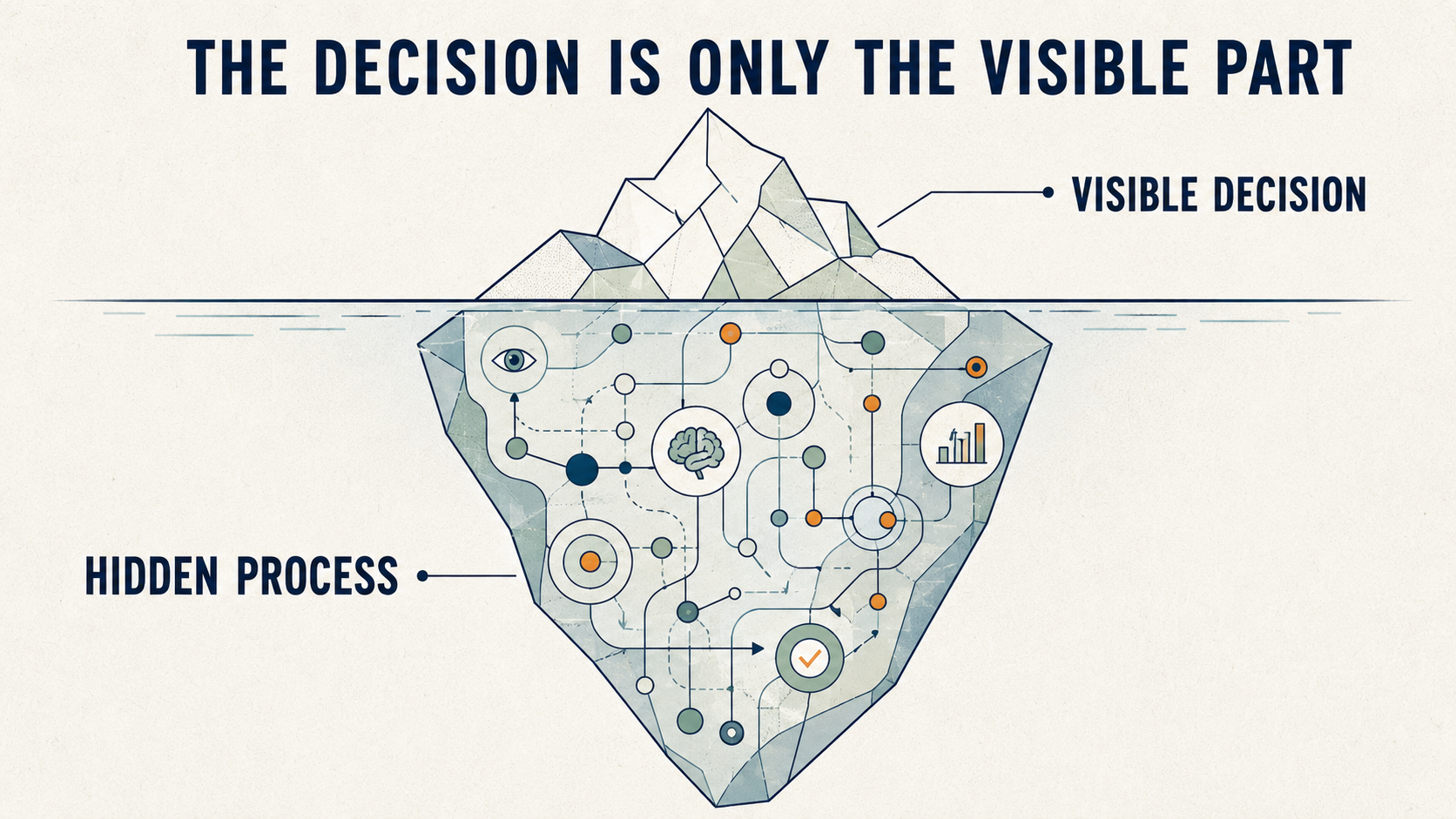
The iceberg metaphor is useful, but only if we do not turn it into a cartoon.
The point is not that there is a mysterious hidden self underneath every decision. The point is simpler and more practical.
A decision has a surface.
Above the surface is what people can observe: the approval, the delay, the refusal, the commitment, the action.
Below the surface is the process that made the decision feel reasonable.
The brain has already filtered the situation. It has selected some information and ignored other information. It has retrieved previous experience. It has estimated risk, urgency, value, and possible consequences. It has made some options feel available and others fade into the background.
By the time someone says, “I think we should do this,” the decision process is already well underway.
This matters because we often analyse decisions too late. We look at what someone chose, then try to explain the choice from the outside.
A better question is: what conditions made that choice feel reasonable at the time?
The Brain State Comes First
A brain state is not the same as a mood or mindset.
In neuroscience, a brain state refers to the current pattern of activity and communication across neural systems. It describes how the brain is operating at a given moment, including which systems are active, how they are connected, and how stable or flexible that configuration is (Braeutigam, 2007; He et al., 2023).
In plain language, a brain state is the brain’s current operating condition.
That condition changes.
Sleep changes it. Fatigue changes it. Hunger changes it. Emotional load changes it. Cognitive load changes it. Time pressure, uncertainty, interruptions, and the accumulated work of the day change it.
This means the same person does not bring the same brain state to every decision.
A decision made after deep sleep and uninterrupted thinking is not made under the same conditions as a decision made after poor sleep, six meetings, constant messages, and a deadline.
The person may have the same values, experience, and intelligence. The operating condition is still different.
That difference matters because brain state shapes the cognitive processes that come next.
The Invisible Work Before the Choice
Cognitive processes are the mental operations the brain uses to work with information.
They are not abstract academic labels. They are the practical machinery of decision-making.
Attention determines what enters the decision at all. If information is not attended to, it cannot properly influence the choice.
Working memory holds information in mind while it is being used. This is essential when a decision requires comparison between risks, goals, constraints, people, and future consequences (Coutlee & Huettel, 2012).
Memory retrieval brings previous experience into the present situation.
Inhibition helps pause the first reactive answer long enough for a more considered response to form.
Reasoning compares evidence, consequences, rules, and assumptions.
Valuation assigns weight to possible outcomes. It helps the brain estimate what is worth pursuing, avoiding, delaying, or protecting.
Emotion also plays a role. It is not separate from decision-making. Emotional signals help mark information as important, urgent, threatening, uncertain, or socially relevant (Phelps et al., 2014).
These processes do not run equally well under all conditions.
When the brain is overloaded, attention may narrow. Working memory may hold fewer variables. The brain may rely more on what is recent, familiar, emotionally vivid, or easy to process.
The person still experiences themselves as deciding.
But the material available for decision-making has changed.
The Cascade Beneath the Decision
The relationship is simple:
Brain state shapes cognitive processing.
Cognitive processing shapes the decision.
The decision becomes visible as action.
That is the neurocognitive cascade beneath every choice.
It explains why a decision can feel clear in the moment and incomplete afterwards. The decision may not have been irrational. It may have been produced by a cognitive system operating under restricted conditions.
This is especially important in professional environments, because many important decisions are made in precisely these conditions.
Too much information.
Too many interruptions.
Too many unresolved issues.
Too much uncertainty.
Too little time to think.
These conditions do not simply make people feel busy. They change what the brain can process, compare, and hold in mind.
Better Information Is Not Enough
Organisations often look rational from the outside.
They have dashboards, reports, budgets, processes, meetings, KPIs, and strategy documents.
These tools can be useful. They can organise information, make patterns visible, and support better choices.
They do not make decisions.
A dashboard does not interpret itself. A report does not weigh its own implications. A strategy document does not decide what matters under uncertainty.
Human brains do that work.
This is why better information does not automatically lead to better decisions. If the person interpreting the information is overloaded, more data can add complexity without improving understanding.
The bottleneck is not always information quality. Sometimes it is processing capacity.
For leaders, teams, and organisations, this is a more precise way to think about decision quality. It is not enough to ask whether the right information was available. We also have to ask whether the people using that information had the cognitive conditions required to use it well.
Looking Underneath the Decision
When a decision goes wrong, we often search for a visible explanation.
The person lacked discipline.
The team resisted change.
The leader made a poor call.
The strategy was wrong.
Sometimes those explanations are accurate. Often, they are incomplete.
A decision that looks like a strategy problem may also involve attention under load. A decision that looks like resistance may involve uncertainty or cognitive overload reducing flexibility. A decision that looks like poor reasoning may have started earlier, when the brain framed the situation too narrowly.
This does not remove responsibility from decision-making.
It makes responsibility more precise.
If we want better decisions, we need to understand the conditions that produce them.
That starts with looking earlier than the final choice.
A Better Question
After I decided not to move to London, I could have described the decision in one sentence: I stayed in Frankfurt.
That sentence would have been true, but it would not have explained much.
The more useful story was what happened underneath. The situation had been reframed. New information entered the decision. Different risks became visible. The option that first felt like relief became less suitable once the wider conditions were considered.
This is the real value of the decision surface.
It reminds us that the visible choice is only the final expression of a deeper process.
Before reviewing a decision, it helps to ask:
- What was the brain state in which this situation was interpreted?
- What information entered the decision, and what may have been missed?
- What felt urgent, risky, valuable, or realistic at the time?
- Was the decision made with enough cognitive capacity to hold the relevant variables in mind?
These questions do not make decision-making perfect. They make it more honest.
The decision is only the visible part.
To understand it, we have to look underneath.
References
Braeutigam, S. (2007). Endogenous context for choice making: A magnetoencephalographic study. International Congress Series, 1300, 627–630.
Chick, C. F., Pardo, S. T., Reyna, V. F., & Goldman, D. A. (2012). Decision making (individuals). In V. S. Ramachandran (Ed.), Encyclopedia of human behavior (2nd ed.). Elsevier. https://doi.org/10.1016/B978-0-12-375000-6.00122-1
Coutlee, C. G., & Huettel, S. A. (2012). The functional neuroanatomy of decision making: Prefrontal control of thought and action. Brain Research, 1428, 3–12. https://doi.org/10.1016/j.brainres.2011.05.053
Fox, J., Cooper, R. P., & Glasspool, D. W. (2013). A canonical theory of dynamic decision-making. Frontiers in Psychology, 4, Article 150. https://doi.org/10.3389/fpsyg.2013.00150
He, Y., Liang, X., Chen, M., Tian, T., Zeng, Y., Liu, J., Hao, L., Xu, J., Taghia, J., He, Y., Tao, S., Dong, Q., & Qin, S. (2023). Development of brain-state dynamics involved in working memory. Cerebral Cortex, 33(11), 7076–7087. https://doi.org/10.1093/cercor/bhad022
Phelps, E. A., Lempert, K. M., & Sokol-Hessner, P. (2014). Emotion and decision making: Multiple modulatory neural circuits. Annual Review of Neuroscience, 37, 263–287. https://doi.org/10.1146/annurev-neuro-071013-014119
Schall, J. D. (2013). Macrocircuits: Decision networks. Current Opinion in Neurobiology, 23(2), 269–274. https://doi.org/10.1016/j.conb.2012.11.009