
Why can’t I stop overthinking?
Aug 20, 2026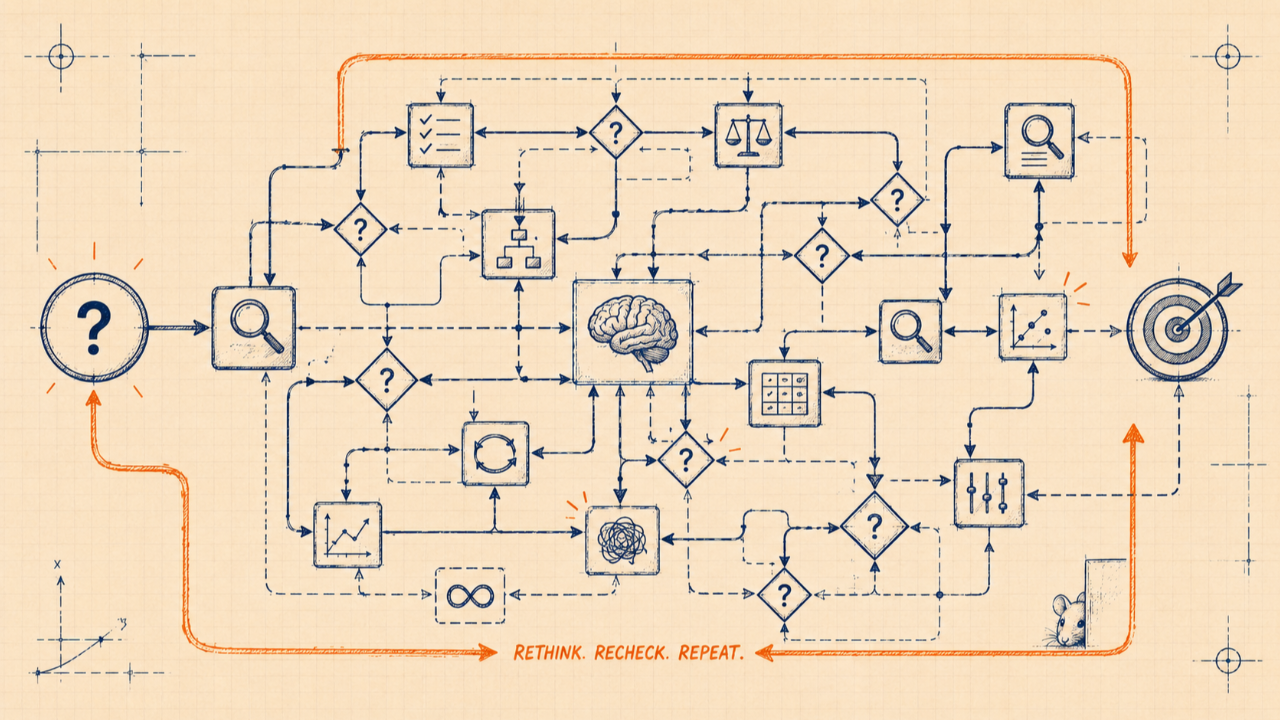
By Gwen Bach, MSc Applied Neuroscience
Published 20 August 2026
Short answer: Overthinking becomes difficult to stop when thinking itself turns into the response to uncertainty, threat or distress. You keep analysing because the brain is still treating the problem as unresolved, while repeated thinking keeps the same material active and makes disengaging harder. The result is a self-reinforcing loop: you think to get certainty or control, but the thinking does not resolve the uncertainty, so the brain keeps returning to it.
You have a difficult conversation at work and later, while you are trying to do something completely different, you find yourself replaying one sentence. You consider what the other person meant, what you should have said, whether you handled it badly and what might happen next. At some point you realise that you have already been through all of this several times, but knowing that does not seem to make your brain leave it alone.
In research, much of what we call overthinking overlaps with rumination, worry and repetitive negative thinking, usually shortened to RNT. Rumination tends to focus more on past events, emotions and their meaning, while worry is more often future-oriented. RNT describes the process they share: negative thinking that becomes repetitive, persistent and difficult to disengage from (De Raedt et al., 2015; Gustavson et al., 2018; Moulds & McEvoy, 2025).
That distinction matters because overthinking is not simply “thinking too much”. Thinking carefully about a problem can be useful. The problem begins when the same material keeps being processed without producing new information, a decision or an action, and yet the brain continues to treat more thinking as the route towards resolution.
So why does it keep doing that?
Mechanism
What turns useful thinking into overthinking?
Thinking is one of the ways we deal with uncertainty and problems, so the process often begins sensibly enough. Something happens that feels important, ambiguous or potentially threatening, and you start analysing it because you want to understand what happened, predict what might happen next or decide what to do.
Research on worry and rumination suggests that people often hold beliefs about the usefulness of this thinking, such as believing that worry helps them prepare, that continued analysis will eventually produce the right answer, or that stopping before the problem feels resolved could mean overlooking something important (Freeston et al., 1994; de Jong-Meyer et al., 2009).
The difficulty starts when the thinking stops producing anything new but continues because the original problem still feels unresolved. At that point, thinking is no longer simply being used to solve the problem; it has become part of the process keeping the problem mentally active.
The loop can therefore look roughly like this:
uncertainty or stress → threat appraisal → repetitive thinking → the issue remains mentally active → uncertainty or distress remains → more repetitive thinking
This helps explain why overthinking can feel productive even when it is not actually moving anywhere. You are still engaged with the problem, so it feels as though you are working on it, but repeated analysis without new information does not necessarily move you any closer to a solution.
Why does uncertainty keep the loop going?
Uncertainty is particularly effective at sustaining repetitive thinking because many uncertain problems do not contain a natural stopping point.
If you need to know when your train leaves, you can check the timetable and close the problem. If you are trying to work out what somebody really meant by an ambiguous comment, whether you have made the right career decision or whether a project will succeed six months from now, the information needed for certainty may simply not exist yet.
Research on intolerance of uncertainty shows that people differ in how threatening or aversive they find not knowing. Greater intolerance of uncertainty has been associated with stronger perceptions of threat, more negative interpretation of ambiguous information, greater information-seeking, and higher levels of both worry and rumination (Bredemeier & Berenbaum, 2008; Dugas et al., 2005; Bartoszek et al., 2022; Yook et al., 2010).
This can create a problem because further analysis is being used to remove uncertainty that cannot currently be removed. The brain receives no clear signal that the issue has been resolved, so the original reason for thinking about it remains.
There is another layer to this. When ambiguous information is repeatedly interpreted in a threatening direction, the uncertainty itself becomes more salient. Experimental and correlational research suggests that intolerance of uncertainty is associated with biases in how ambiguous information is interpreted and recalled, meaning that an unclear situation can continue to be treated as potentially threatening even without any new evidence that something is actually wrong (Dugas et al., 2005; Deschênes et al., 2010).
The result is a fairly efficient loop: the brain keeps analysing because it does not know, and the repeated analysis keeps reminding it that it still does not know.
Why is it difficult to shift your attention away?
Once repetitive thinking is underway, stopping it requires more than simply deciding that you have had enough.
Rumination has been associated with difficulties in several aspects of cognitive control, including inhibiting information that is already active and switching attention away from internally generated material (Whitmer & Banich, 2007; Rochat et al., 2012; Koster et al., 2013).
In ordinary language, that means the problem is not merely that the thought is present. Your brain also has to stop prioritising that thought and redirect attention towards something else, and that process can become more difficult when the material is emotionally significant and has been repeatedly rehearsed.
There is also evidence that repetitive thinking can become increasingly habit-like. Van Vugt and van der Velde (2018) developed a cognitive model in which rumination repeatedly retrieves negative material during internally generated thought, which helps explain why the same topic can return without a deliberate decision to start analysing it again.
You may therefore genuinely intend to stop thinking about something, begin another task and then realise ten minutes later that your attention has drifted back to exactly the same problem. The thought has become highly accessible, which makes it more likely to be retrieved again whenever attention is no longer strongly occupied elsewhere.
What is happening in the brain?
There is no single brain region responsible for overthinking, and claims that one particular area simply “causes” rumination go beyond what the evidence supports.
Neuroimaging research instead points towards interactions between several large-scale brain systems. The default mode network, or DMN, is involved in internally directed thought, autobiographical memory and self-referential processing. The frontoparietal control network contributes to maintaining goals, directing attention and shifting between mental operations, while the salience network, which includes regions such as the anterior insula and dorsal anterior cingulate cortex, helps determine which internal or external information deserves priority.
Studies of rumination have repeatedly found differences in activity or functional connectivity within and between these systems (Hamilton et al., 2015; Jacob et al., 2020; Chen & Yan, 2021; Zhou et al., 2020).
Functional connectivity does not mean that two brain regions are physically connected by a special “overthinking pathway”. It refers to the extent to which activity in different parts of the brain changes together over time. When researchers report altered connectivity between networks during rumination, they are describing differences in how those systems appear to coordinate their activity.
The broad pattern fits the behavioural research reasonably well: internally generated, self-relevant material remains active and salient, while the systems involved in redirecting attention and regulating that material do not consistently bring the process to an end.
However, most of this imaging evidence is correlational, and much of it comes from people with depression or other clinical conditions. It can therefore tell us which network patterns are associated with rumination, but it cannot establish that a particular pattern of brain activity causes everyday overthinking.
Why can stress make overthinking harder to stop?
Stress gives the brain more unresolved material to process and can also make disengaging from that material more difficult.
The perseverative cognition hypothesis proposes that worry and rumination can extend the physiological effects of a stressor beyond the period in which the stressor itself is present. Research has found that repetitive thinking can interfere with emotional and physiological recovery following stress, meaning that the meeting, argument or problem may be over externally while its representation continues to activate the stress response internally (Brosschot et al., 2006; Capobianco et al., 2018).
Attentional control also appears to matter. Research has linked poorer attentional control with more repetitive negative thinking and poorer mood recovery, while longitudinal work suggests that cognitive-control difficulties and stress can reinforce one another over time (Kertz et al., 2017; Taylor & Snyder, 2023).
This is one reason overthinking often becomes more noticeable during periods of high workload, interpersonal conflict or sustained uncertainty. There is simply more unresolved material available, and the cognitive systems needed to redirect attention are operating under more demanding conditions.
Evidence
Is all repetitive thinking harmful?
No. Repetition by itself is not the problem.
Watkins (2008) distinguished between constructive and unconstructive forms of repetitive thought and showed that repeatedly thinking about a problem can be useful when the processing is concrete, specific and leads towards resolution.
Thinking through the practical consequences of a decision, identifying what went wrong in a project or planning how to handle a difficult conversation can all involve repeated thought without becoming rumination.
The important difference is whether the thinking changes anything. Constructive problem-solving produces something that was not there before, such as new information, a clearer decision, a specific plan or an action. Repetitive negative thinking keeps processing essentially the same material without creating a meaningful next step.
That distinction gives us a much more useful definition of overthinking than simply measuring how many minutes somebody has spent thinking about a problem.
Is repetitive negative thinking linked only to anxiety or depression?
No. Repetitive negative thinking is increasingly described as a transdiagnostic process, which means that it appears across several different forms of psychological difficulty rather than belonging to one diagnosis.
Research has identified a common RNT component across rumination, worry, anxiety and depression, and longitudinal and cross-sectional work shows that the same underlying repetitive process can predict symptoms across diagnostic categories (Gustavson et al., 2018; Taylor & Snyder, 2021; Moulds & McEvoy, 2025).
This does not mean that ordinary overthinking is evidence of a mental-health disorder. It means that the cognitive process itself is not unique to one condition and can also appear during ordinary periods of uncertainty, stress or difficult life circumstances.
Can treatments that target repetitive thinking actually reduce it?
Yes, although the evidence is stronger for some approaches than others.
Rumination-focused and RNT-focused cognitive behavioural interventions directly target the processes that keep repetitive thinking going rather than treating rumination only as a secondary symptom. Randomised trials have reported reductions in repetitive negative thinking, worry, anxiety and depressive symptoms following these interventions (Joubert et al., 2023; Wallsten et al., 2023; Tulbure et al., 2025).
A meta-analysis of CBT for depression also found reductions in repetitive negative thinking, suggesting that broader cognitive behavioural approaches can change the process even when rumination is not the sole treatment target (Spinhoven et al., 2018).
This matters because it shows that repetitive thinking is not simply a fixed personality trait. The processes involved in it can be changed.
Application
Turn the loop into a closed problem
One practical way to interrupt overthinking is to stop allowing problem-solving to remain open-ended.
The following exercise is a structured application of the distinction between constructive problem-solving and repetitive processing. It is not a named treatment protocol, but its components are consistent with CBT-based problem-solving and planned coping approaches, as well as with research distinguishing useful from unconstructive repetitive thought (Watkins, 2008; Machmutow et al., 2018; Zhang et al., 2018).
Take a sheet of paper and divide it into three sections:
1. What is known now
Write only information that is actually available, including facts, decisions already made and anything that does not require guessing another person’s thoughts or predicting the future.
If the issue is an unclear email from your manager, for example, “The email asked me to revise the report by Friday” belongs here. “She thinks I am incompetent” does not, because that information is not available.
2. What can be acted on now
Write the smallest observable action that could move the situation forwards with the information you currently have.
That might be sending one clarifying email, checking one piece of data, fixing one specific problem or making one provisional decision.
Give the action a time or trigger so that it becomes something that can actually happen: “At 9:00 tomorrow I will email X for clarification” is more useful than “I need to sort this out”.
Once an action exists, further thinking is only useful if it changes that action.
3. What cannot currently be known
Put any information that genuinely does not exist yet in this section: another person’s private judgement, the outcome of a future event, whether a decision will eventually prove to have been perfect, or information that will only become available later.
Give that material a review point tied to new information rather than continuing to analyse it indefinitely. If the project outcome will be clearer after Friday’s meeting, Friday’s meeting becomes the next review point. Until then, the problem is temporarily closed because no amount of additional analysis can create the missing evidence.
Finally, write one return rule for when the same loop starts again:
If I notice myself analysing this again before new information is available, I will check the page once, confirm that there is no new action, and return to the task I had chosen to do next.
The aim is not to make the thought disappear. The aim is to stop treating repeated thought as if it were still producing information when the problem has already reached the limit of what can currently be known or done.
That gives the brain something repetitive thinking often lacks: a defined endpoint.
References
Bartoszek, G., Ranney, R. M., Curanovic, I., et al. (2022). Intolerance of uncertainty and information-seeking behavior: Experimental manipulation of threat relevance. Behaviour Research and Therapy. https://doi.org/10.1016/j.brat.2022.104125
Bredemeier, K., & Berenbaum, H. (2008). Intolerance of uncertainty and perceived threat. Behaviour Research and Therapy. https://doi.org/10.1016/j.brat.2007.09.006
Brosschot, J. F., Gerin, W., & Thayer, J. F. (2006). The perseverative cognition hypothesis: A review of worry, prolonged stress-related physiological activation, and health. Journal of Psychosomatic Research. https://doi.org/10.1016/j.jpsychores.2005.06.074
Capobianco, L., Morris, J. A., & Wells, A. (2018). Worry and rumination: Do they prolong physiological and affective recovery from stress? Anxiety, Stress & Coping. https://doi.org/10.1080/10615806.2018.1438723
Chen, X., & Yan, C.-G. (2021). Hypostability in the default mode network and hyperstability in the frontoparietal control network of dynamic functional architecture during rumination. NeuroImage. https://doi.org/10.1016/j.neuroimage.2021.118427
de Jong-Meyer, R., Beck, B., & Riede, K. (2009). Relationships between rumination, worry, intolerance of uncertainty and metacognitive beliefs. Personality and Individual Differences. https://doi.org/10.1016/j.paid.2008.12.010
De Raedt, R., Hertel, P. T., & Watkins, E. R. (2015). Mechanisms of repetitive thinking: Introduction to the special series. Clinical Psychological Science. https://doi.org/10.1177/2167702615584309
Deschênes, S. S., Dugas, M. J., Radomsky, A. S., & Buhr, K. (2010). Experimental manipulation of beliefs about uncertainty: Effects on interpretive processing and access to threat schemata. Journal of Experimental Psychopathology. https://doi.org/10.5127/jep.008510
Dugas, M. J., Hedayati, M., Karavidas, A., et al. (2005). Intolerance of uncertainty and information processing: Evidence of biased recall and interpretations. Cognitive Therapy and Research. https://doi.org/10.1007/s10608-005-1648-9
Freeston, M. H., Rhéaume, J., Letarte, H., et al. (1994). Why do people worry? Personality and Individual Differences. https://doi.org/10.1016/0191-8869(94)90048-5
Gustavson, D. E., Pont, A. D., Whisman, M. A., & Miyake, A. (2018). Evidence for transdiagnostic repetitive negative thinking and its association with rumination, worry, and depression and anxiety symptoms: A commonality analysis. Collabra: Psychology. https://doi.org/10.1525/collabra.128
Hamilton, J. P., Farmer, M., Fogelman, P., & Gotlib, I. H. (2015). Depressive rumination, the default-mode network, and the dark matter of clinical neuroscience. Biological Psychiatry. https://doi.org/10.1016/j.biopsych.2015.02.020
Jacob, Y., Morris, L. S., Huang, K.-H., et al. (2020). Neural correlates of rumination in major depressive disorder: A brain network analysis. NeuroImage: Clinical. https://doi.org/10.1016/j.nicl.2019.102142
Joubert, A. E., Grierson, A. B., Li, I., et al. (2023). Managing rumination and worry: A randomised controlled trial of an internet intervention targeting repetitive negative thinking delivered with and without clinician guidance. Behaviour Research and Therapy. https://doi.org/10.1016/j.brat.2023.104378
Kertz, S. J., Stevens, K. T., & Klein, K. P. (2017). The association between attention control, anxiety, and depression: The indirect effects of repetitive negative thinking and mood recovery. Anxiety, Stress & Coping. https://doi.org/10.1080/10615806.2016.1260120
Koster, E. H. W., de Lissnyder, E., & De Raedt, R. (2013). Rumination is characterized by valence-specific impairments in switching of attention. Acta Psychologica. https://doi.org/10.1016/j.actpsy.2013.09.008
Machmutow, K., Grosse-Holtforth, M. G., Krieger, T., & Watzke, B. (2018). Identifying relapse prevention elements during psychological treatment of depression: Development of an observer-based rating instrument. Journal of Affective Disorders. https://doi.org/10.1016/j.jad.2017.11.009
Moulds, M. L., & McEvoy, P. M. (2025). Repetitive negative thinking as a transdiagnostic cognitive process. Nature Reviews Psychology. https://doi.org/10.1038/s44159-024-00399-6
Rochat, L., Billieux, J., & Van der Linden, M. (2012). Difficulties in disengaging attentional resources from self-generated thoughts moderate the link between dysphoria and maladaptive self-referential thinking. Cognition and Emotion. https://doi.org/10.1080/02699931.2011.613917
Spinhoven, P., Klein, N., Kennis, M., et al. (2018). The effects of cognitive-behavior therapy for depression on repetitive negative thinking: A meta-analysis. Behaviour Research and Therapy. https://doi.org/10.1016/j.brat.2018.04.002
Taylor, M. M., & Snyder, H. R. (2021). Repetitive negative thinking shared across rumination and worry predicts symptoms of depression and anxiety. Journal of Psychopathology and Behavioral Assessment. https://doi.org/10.1007/s10862-021-09898-9
Taylor, M. M., & Snyder, H. R. (2023). Dependent stress generation mediates the relation between poor cognitive control and repetitive negative thinking in emerging adults. Emerging Adulthood. https://doi.org/10.1177/21676968211054969
Tulbure, B. T., Dudău, D. P., Marian, Ș., & Watkins, E. (2025). An internet-delivered rumination-focused CBT intervention for adults with depression and anxiety: A randomized controlled trial. Behavior Therapy. https://doi.org/10.1016/j.beth.2024.12.004
van Vugt, M. K., & van der Velde, M. (2018). How does rumination impact cognition? A first mechanistic model. Topics in Cognitive Science. https://doi.org/10.1111/tops.12318
Wallsten, D., Norell, A., Anniko, M., et al. (2023). Treatment of worry and comorbid symptoms within depression, anxiety, and insomnia with a group-based rumination-focused cognitive-behaviour therapy in a primary health care setting: A randomised controlled trial. Frontiers in Psychology. https://doi.org/10.3389/fpsyg.2023.1196945
Watkins, E. R. (2008). Constructive and unconstructive repetitive thought. Psychological Bulletin. https://doi.org/10.1037/0033-2909.134.2.163
Whitmer, A. J., & Banich, M. T. (2007). Inhibition versus switching deficits in different forms of rumination. Psychological Science. https://doi.org/10.1111/j.1467-9280.2007.01936.x
Yook, K., Kim, K.-H., Suh, S. Y., & Lee, K. S. (2010). Intolerance of uncertainty, worry, and rumination in major depressive disorder and generalized anxiety disorder. Journal of Anxiety Disorders. https://doi.org/10.1016/j.janxdis.2010.04.003
Zhang, Z., Zhang, L., Zhang, G., et al. (2018). The effect of CBT and its modifications for relapse prevention in major depressive disorder: A systematic review and meta-analysis. BMC Psychiatry. https://doi.org/10.1186/s12888-018-1610-5
Zhou, H.-X., Chen, X., Shen, Y.-Q., et al. (2020). Rumination and the default mode network: Meta-analysis of brain imaging studies and implications for depression. NeuroImage. https://doi.org/10.1016/j.neuroimage.2019.116287