
Why do I keep putting off decisions I need to make?
Aug 21, 2026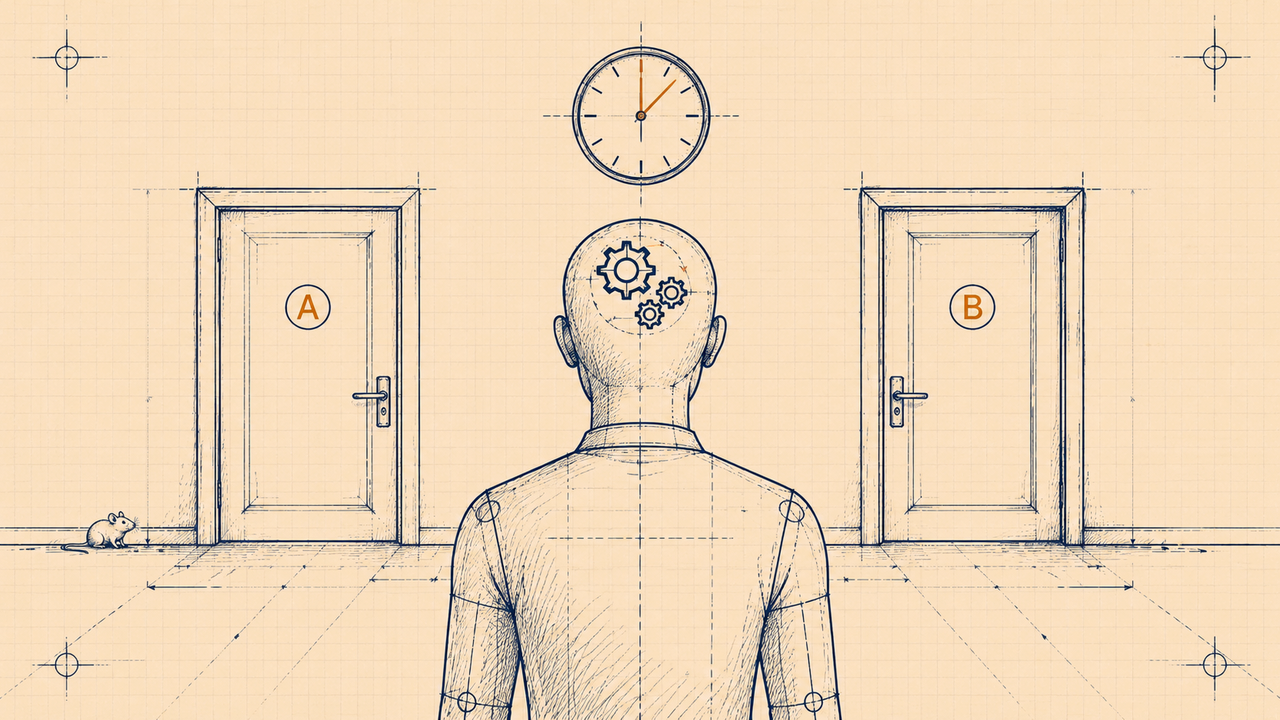
By Gwen Bach, MSc Applied Neuroscience
Published 21 August 2026
Short answer: You may keep putting off decisions because choosing has an immediate cost: you have to tolerate uncertainty, give up alternative options, risk regret and expend mental effort. Delaying lets you avoid those costs for a little longer. The problem is that postponement rarely removes the decision; it simply leaves it open, so you often return to the same uncertainty later with more pressure attached to it.
You know the decision needs making. Maybe you need to choose whether to take a job, end a project, hire someone, spend the money, change direction, say yes, say no — or finally pick between two options you have been comparing for what now feels like an absurd amount of time.
And perhaps you have already done plenty of thinking.
You have read the reviews. Made the spreadsheet. Asked three people. Thought about what could go wrong. Thought about what could go right. Reopened the spreadsheet. Found another option. Closed everything because you were fed up with it.
Then a few days later the decision is still there.
This can look like a lack of discipline from the outside, but decision delay makes rather more sense when you look at what choosing actually requires. A decision closes possibilities. It creates responsibility for an outcome you cannot completely predict. It may involve giving something up, and if several options are reasonably good, there may be no piece of information that suddenly makes one of them obviously correct.
So the question becomes: why can waiting feel easier than making a decision you already know needs to be made?
Mechanism
Why does putting the decision off feel easier than choosing?
Making a decision means committing to one course of action while accepting that another option may have turned out better.
Until you choose, that discomfort remains theoretical. You have not yet made the “wrong” decision. You have not closed the other door. You are also not yet responsible for whatever happens afterwards.
Decision avoidance can therefore become attractive because it allows you to stop the difficult part of the process, at least temporarily. Researchers describe several forms of decision avoidance, including maintaining the status quo, doing nothing, delegating the choice and explicitly deferring it (Han et al., 2023).
This does not necessarily mean you consciously think, I would like to avoid responsibility for this, so I shall postpone it indefinitely.
It can be far less dramatic than that.
You open the document, think about the options, feel uncertain, decide you need a little more information and go back to something easier.
The decision has not disappeared, but the immediate demand to choose has.
Research on procrastination more broadly shows a similar temporal problem. Le Bouc and Pessiglione (2022), for example, found that procrastination was associated with the way people represented the effort required now versus later: effort appeared to lose more of its subjective cost when pushed into the future. In other words, later can genuinely look easier from where you are sitting today.
Why does uncertainty make a decision harder?
Many important decisions do not contain enough information to produce certainty.
You can investigate whether a new job looks promising, whether a business idea is viable or whether moving house is sensible. What you cannot do is inspect the future and discover exactly what will happen after you choose.
That matters because uncertainty itself can make choice aversive. Anticipated regret can increase uncertainty aversion: if you are already imagining how awful it would feel to discover that the other option was better, gathering more information can seem like protection against making a mistake (Krähmer & Stone, 2013).
Sometimes it is protection. More information can improve a decision.
But eventually you can reach a point where the problem is no longer that you lack information. You lack certainty, and those are not the same thing.
This is where decision-making can quietly turn into information-seeking without an end point. Every additional piece of information produces another question, another comparison or another scenario to consider.
You are still technically “working on the decision”, but you are no closer to making one.
Why does having more options sometimes make it worse?
A decision also becomes harder as the comparison itself becomes more demanding.
If you are choosing between two clearly different options and you know what matters to you, the task may be relatively simple. Give yourself eight similar alternatives, twenty-six criteria and several uncertain outcomes, and you now have much more information to hold, compare and weigh.
Research on choice overload suggests that the number of options alone is not the whole story. Choice becomes particularly difficult when the alternatives are complex, the decision itself is difficult and people are uncertain about their own preferences (Chernev et al., 2015).
That is an important distinction because “too much choice causes paralysis” is a little too neat.
Ten options may be perfectly manageable if you know exactly what you are looking for. Three can be horrible if each requires a painful trade-off.
Gerasimou (2018) describes several conditions under which people may rationally defer choice, including difficulty distinguishing between alternatives, unattractive options and complexity. Sometimes postponing really is sensible because the available choice is poor or the information is incomplete.
The problem begins when the extra time is no longer changing the decision.
Why does fear of regret keep you stuck?
Imagine choosing option A.
Now imagine discovering six months later that option B would have worked brilliantly.
That anticipated comparison can influence the choice before anything has actually happened. Regret is unusual in that it involves not only disliking the outcome you received, but comparing it with an outcome you imagine you could have had.
So you may start trying to choose the option that protects you from future self-blame.
And unfortunately, there is often no such option.
Every meaningful choice carries an opportunity cost. Choosing one job means not experiencing the other one. Spending the money here means not spending it somewhere else. Committing to one strategy means temporarily abandoning several alternatives.
The more you demand a decision that guarantees you will never look back and think perhaps I should have chosen differently, the harder commitment becomes.
Decision delay therefore often persists because waiting postpones several uncomfortable things at once: uncertainty, effort, trade-offs, responsibility and the possibility of regret.
Evidence
Does avoiding a decision actually prevent regret?
This is where the research gets interesting.
A common explanation for decision avoidance is that people use it to reduce anticipated regret or responsibility for a potentially bad outcome. But Han et al. (2023) tested this assumption in a systematic review and meta-analysis covering 59 effect estimates from 13 papers.
Across the decision-avoidance strategies combined, there was only a small, statistically non-significant tendency towards lower regret. Of the individual strategies examined, maintaining the status quo reliably reduced regret; the evidence was unclear for the others, including choice deferral.
So avoiding a decision may feel like protection from regret before the choice, but we should not assume that postponing reliably makes people less regretful afterwards.
That distinction matters.
The attraction of delay lies partly in what it allows you to avoid now. Whether it actually improves the eventual outcome or your feelings about it is another question.
Is indecision simply procrastination?
No. They overlap, but they are not identical.
Indecisiveness describes difficulty making choices, whereas procrastination involves voluntarily delaying an intended action despite expecting the delay to have costs. Lauderdale et al. (2024) found evidence that the two are distinct constructs rather than different names for the same thing.
You can therefore procrastinate on a decision without being generally indecisive, and you can be indecisive without displaying every other feature associated with procrastination.
For this particular problem, however, the overlap is useful because procrastination research helps explain why postponement itself can become attractive. Le Bouc and Pessiglione's (2022) work suggests that delaying effort changes its perceived cost: doing something later can look considerably easier than doing it now.
That creates a rather nasty little bargain.
You get relief from making the decision today, while tomorrow-you inherits the same decision.
Does overwhelm make decision delay more likely?
It can.
Decisions require you to maintain relevant information, ignore what does not matter, compare alternatives and resolve trade-offs. Cognitive load makes those processes harder, and research shows that additional load can change judgement and decision behaviour (Deck & Jahedi, 2015).
Choice-overload research points in the same direction. The effects are strongest not simply when there are “lots of options”, but when the choice set is difficult to process, the task is complex and your preferences are uncertain (Chernev et al., 2015).
This helps explain why a decision you could probably make quite comfortably on a quiet Tuesday morning can become almost impossible when you are already trying to hold seventeen other things in your head.
And this is also why endlessly expanding the decision — another tab, another opinion, another comparison — can eventually make matters worse rather than better.
Application
A solution-focused way to get a decision moving
When you have been stuck on a decision for a while, the natural temptation is to analyse it harder.
Why can't I decide? What am I afraid of? What if I get this wrong? What else should I consider?
Sometimes those are useful questions. Sometimes they simply create another hour of thinking about the fact that you cannot decide.
A different approach comes from Solution-Focused Brief Therapy (SFBT). Rather than spending most of the time analysing the origins of a problem, solution-focused approaches direct attention towards the preferred future, occasions when the problem is less severe, existing resources and small signs of progress.
There is evidence that these kinds of questions can change what people generate. In an experimental study, Neipp-López et al. (2021) found that solution-focused miracle and exception questions reduced negative affect more than problem-focused questions, while scaling questions produced more concrete action steps. Takagi et al. (2022) also found that clarifying future solution pictures affected aspects of goal reality and future-oriented attitudes.
That does not mean SFBT has been established as a specific treatment for decision procrastination. Direct evidence for indecision is much thinner. But its question structure gives us a useful way of changing the task from solve this entire uncertain decision to identify what moving forward would actually look like.
Try this on paper rather than doing it entirely in your head:
- Describe the preferred future. Imagine the decision is no longer hanging over you. Do not ask which option turned out to be objectively perfect — you cannot know that. Ask: What would I notice was different once I had made a decision I could live with? What would you be doing? What would you no longer be spending time on? What would become possible because the decision had been made?
- Look for an exception. Think of another decision you once expected to find difficult but handled reasonably well. What was different then? Perhaps you knew your priority. Perhaps you gave yourself a deadline. Perhaps you accepted that there was no perfect answer. Perhaps you asked one person instead of seven. The important question is: What did you already do that helped you move?
- Use a scale. On a scale from 0 to 10, where 0 means “I cannot make this decision at all” and 10 means “I am ready to choose”, where are you now? Then ask the very SFBT question: Why are you not one point lower? That forces you to identify what you already know, what resources you already have and what part of the decision is already clearer than it feels.
- Ask what would move you one point. Not from 4 to 10. From 4 to 5. What is the smallest useful thing that would make the decision easier? Perhaps one missing fact genuinely matters. Perhaps you need to eliminate an option. Perhaps you need to decide which criterion matters most. Perhaps the next step is simply to stop gathering information and choose.
There is a subtle shift here.
You are no longer demanding, How can I become completely certain that I am making the right decision?
You are asking, What do I already know, what would good enough look like, and what would help me move one step from here?
For decisions involving genuine risk or major consequences, more investigation may of course be necessary. Waiting is not automatically irrational. Sometimes you really do need more information.
But you can test that quite simply:
What specific information am I waiting for, and what would I do differently once I had it?
If you can answer that, go and get the information.
If you cannot, there is a reasonable chance that what you are waiting for is not more information at all.
You may be waiting to feel certain.
And some decisions simply never give you that before you make them.
References
Abdulla, A., & Woods, R. (2023). The effect of solution-focused scaling and solution-focused questions on expectancy and commitment. School Psychology Review, 52(6), 709–720. https://doi.org/10.1080/2372966X.2021.1942196
Bhatia, S., & Mullett, T. L. (2016). The dynamics of deferred decision. Cognitive Psychology, 86, 112–151. https://doi.org/10.1016/j.cogpsych.2016.02.002
Chernev, A., Böckenholt, U., & Goodman, J. (2015). Choice overload: A conceptual review and meta-analysis. Journal of Consumer Psychology, 25(2), 333–358. https://doi.org/10.1016/j.jcps.2014.08.002
Deck, C., & Jahedi, S. (2015). The effect of cognitive load on economic decision making: A survey and new experiments. European Economic Review, 78, 97–119. https://doi.org/10.1016/j.euroecorev.2015.05.004
Gerasimou, G. (2018). Indecisiveness, undesirability and overload revealed through rational choice deferral. The Economic Journal, 128(614), 2450–2479. https://doi.org/10.1111/ecoj.12500
Han, Q., Quadflieg, S., & Ludwig, C. J. H. (2023). Decision avoidance and post-decision regret: A systematic review and meta-analysis. PLOS ONE, 18(10), e0292857. https://doi.org/10.1371/journal.pone.0292857
Krähmer, D., & Stone, R. (2013). Anticipated regret as an explanation of uncertainty aversion. Economic Theory, 52, 709–728. https://doi.org/10.1007/s00199-011-0661-3
Lauderdale, S. A., Lahman, K. R., & Desai, H. (2024). Clarifying some confusion: Indecisiveness and procrastination are distinct constructs. Current Psychology. https://doi.org/10.1007/s12144-024-06790-z
Le Bouc, R., & Pessiglione, M. (2022). A neuro-computational account of procrastination behavior. Nature Communications, 13, 5639. https://doi.org/10.1038/s41467-022-33119-w
Neipp-López, M.-C., Beyebach, M., Sánchez-Prada, A., & Delgado-Álvarez, M. del C. (2021). Solution-focused versus problem-focused questions: Differential effects of miracles, exceptions and scales. Journal of Family Therapy, 43(4), 728–747. https://doi.org/10.1111/1467-6427.12345
Takagi, G., Sakamoto, K., Nihonmatsu, N., & Hagidai, M. (2022). The impact of clarifying the long-term solution picture through solution-focused interventions on positive attitude towards life. PLOS ONE, 17(5), e0267107. https://doi.org/10.1371/journal.pone.0267107