
Why do I keep repeating behaviours I want to change?
Aug 17, 2026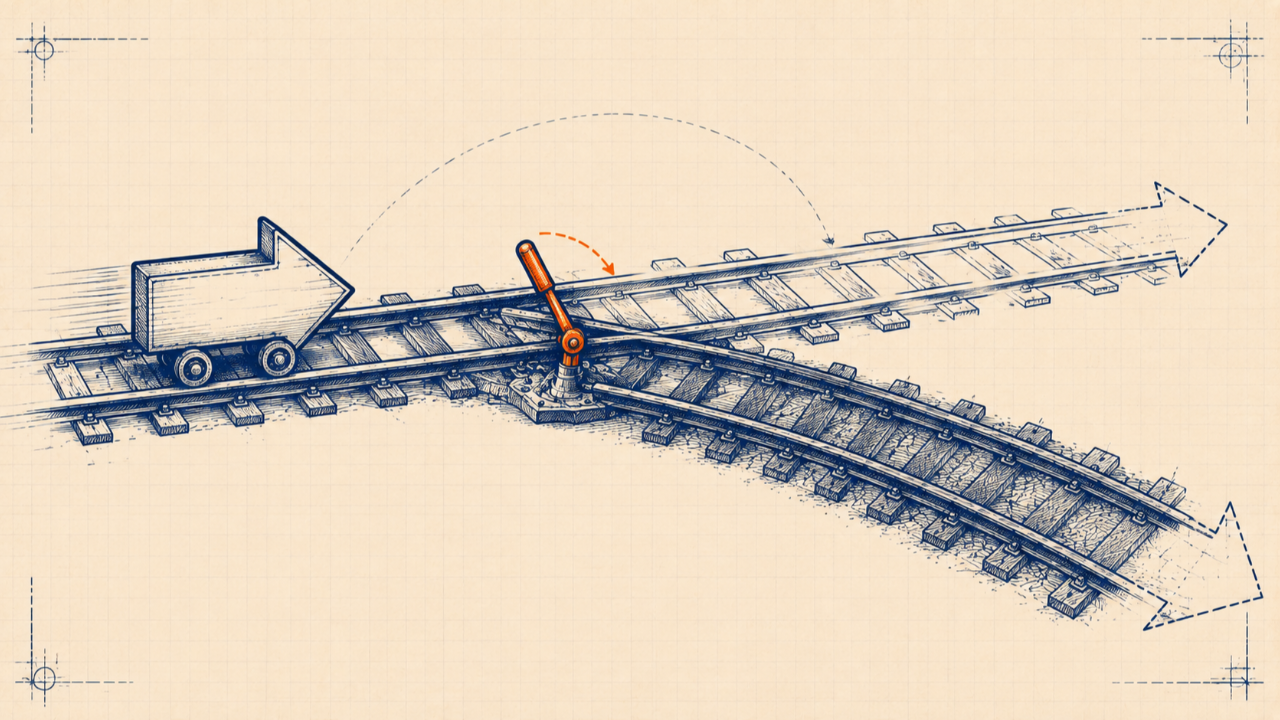
By Gwen Bach, MSc Applied Neuroscience
Published 17 August 2026
Short answer: Repeated behaviours become linked to cues in the situations where we perform them. When those cues appear again, the familiar response becomes easier to start, particularly when it also provides an immediate reward or relief. Stress and overwhelm can make it harder for our intentions to compete with these well-practised responses. Changing the behaviour therefore usually requires changing the cue-response pattern, not simply wanting the outcome more.
You promise yourself you won’t do it again… and then you do.
-
You open your phone for five minutes and suddenly 45 minutes have disappeared.
-
You keep eating in the evening even though you decided this morning that you wanted to lose weight.
-
You avoid the same important task again, even though you are getting increasingly frustrated with yourself for not doing it.
And the particularly annoying thing is that you often know exactly what you are doing while you are doing it. You are not confused about whether scrolling instead of working on your project is helping. You know it isn’t. Yet somehow the same behaviour keeps turning up.
So why are repeated behaviours so stubborn, particularly when life is stressful and you are already feeling overloaded?
Mechanism
Why does the old behaviour happen so automatically?
The first thing to understand is that repeated behaviour does not start from zero every time.
When you repeatedly do something in the same situation, the situation itself can become linked to the behaviour. It might be a time of day, a place, something that happens immediately beforehand or even a particular internal state. Over time, encountering that cue makes the familiar response easier to start (Gardner, 2015; Orbell & Verplanken, 2010; Wood & Neal, 2009).
Take doomscrolling. Maybe you rarely do it in the morning when you are rested and have somewhere to be. But at 6.30 p.m., after a day of meetings, emails, interruptions and minor annoyances, you sit on the sofa with your phone next to you. You check one thing. Half an hour later you are still there.
That particular sequence has probably happened before. The end of the workday, the sofa and the phone are not neutral anymore. They are part of a context in which you have repeatedly performed the same behaviour.
And the behaviour usually does something for you in the short term. Scrolling gives you distraction. Food can feel comforting. Avoiding the difficult email removes the discomfort of dealing with it. Netflix means that for the next hour nobody is asking you to solve another problem.
That immediate payoff matters because behaviour that repeatedly produces a rewarding or relieving consequence becomes more likely to occur again.
Why do stress and overwhelm make this harder?
Now add stress and overwhelm.
Modern life gives us an impressive number of opportunities to practise this. Notifications, digital overload, unfinished work, decisions, interruptions, family logistics, financial worries, bad news and twenty small things that still need doing all compete for attention. By the evening you may not be experiencing some dramatic acute stress response. You may simply be mentally full.
That state does not magically switch your brain into “habit mode”, and we should be careful with the popular idea that willpower works like a battery that simply runs out. Evidence for the classic ego-depletion model is much weaker than it is often presented (Carter et al., 2015).
But your state still matters. Psychological distress can weaken the relationship between what people intend to do and what they subsequently do, and negative affect and difficulties regulating emotion are associated with greater behavioural dysregulation (McGarrity et al., 2017; Seah & Coifman, 2022).
So the old behaviour has several things going for it at exactly the moment when you are most likely to repeat it: it is familiar, strongly cued, easy to access and it gives you something immediately.
The new behaviour often has none of those advantages.
Going for a walk, working on the book, cooking dinner or sitting down with the finances may require you to stop what you are doing, remember the larger goal, tolerate some discomfort and start something effortful whose reward comes much later.
That is quite a competition.
Repeated unwanted behaviour is therefore often not a failure of knowledge or intention. The old response has been practised in a particular context, is triggered by familiar cues and frequently provides an immediate reward or relief.
Evidence
What does habit research show?
Habit research consistently shows that repeated behaviours become associated with the contexts in which they occur. Habit is often described as cue-contingent automaticity: particular situations make a learned response more readily available without requiring the same deliberate decision each time (Gardner, 2015; Orbell & Verplanken, 2010).
This is also why changes in context can change behaviour. Wood, Tam and Witt (2005) found that disruptions in life circumstances can weaken existing habits when the cues that normally support them change. Verplanken and Wood (2006) similarly argued that disrupting the environmental conditions supporting an established behaviour can create an opportunity for change.
The important point is that deciding to stop a behaviour does not automatically remove the cues and learned associations that helped create it.
Does stress really make us fall back on habits?
The evidence here is more nuanced than many popular explanations suggest.
We cannot say that every stressful day automatically pushes the brain into habitual behaviour, and the idea that self-control is simply depleted through use is contested (Carter et al., 2015).
What the research does support is that psychological state can influence how successfully intentions become behaviour. McGarrity and colleagues (2017), for example, found that psychological distress moderated the relationship between intention and subsequent behaviour in the health behaviour they studied. Seah and Coifman’s (2022) meta-analysis also found associations between emotion differentiation and behavioural dysregulation.
So a more defensible explanation is not that stress simply switches the brain into “habit mode”. It is that stress and distress can make it harder for a goal-directed intention to compete with an already familiar and immediately rewarding response.
Can old cue-response patterns actually change?
There is good reason to think they can.
Research on extinction, renewal and relapse shows that reducing a behaviour does not necessarily erase the original learning. Old responses can return when the context changes or familiar cues reappear (Bezzina et al., 2016).
Counterconditioning research is interesting for the same reason. Van Gucht and colleagues (2010), for example, found that changing what a cue predicted reduced cue-induced craving and actual consumption. Habit-reversal interventions also show that established repetitive behaviours can be changed by identifying their triggers and deliberately altering the response (Bate et al., 2011).
Some of the strongest work on extinction and relapse comes from substance-use research and animal models, so we should not pretend that laboratory cocaine relapse and checking Instagram after dinner are the same thing.
But the underlying learning principle is useful: old cue-response relationships can persist even after behaviour changes, and changing what repeatedly happens in the presence of a cue can alter those relationships.
Application
Once you understand the problem this way, “How do I stop myself?” is probably not the most useful first question.
Ask instead:
What keeps launching this behaviour?
1. Find the cue
For the next few times the behaviour happens, do not try to analyse your entire childhood or personality. Just look at the few minutes immediately before it.
Write down:
-
Where was I?
-
What time was it?
-
What was I doing immediately beforehand?
-
What happened just before it?
-
What was I feeling or thinking?
-
What did I then do?
-
What did that behaviour give me immediately?
You are looking for repetition.
Maybe the chocolate always appears after you finally sit down at night.
Maybe you start scrolling whenever you hit uncertainty in your work.
Maybe you order food when you come home late and realise there is nothing obvious to cook.
Maybe procrastination appears whenever the next step of a project is unclear.
The aim is to find the point at which the behaviour is being launched rather than concentrating only on the behaviour once it is already happening.
2. Disrupt the old sequence
Once you see the cue, change something before the familiar behaviour starts.
If your phone beside you on the sofa reliably launches scrolling, put it somewhere else before you sit down.
If opening your laptop leads automatically to your inbox, change what opens first.
If coming home exhausted leads to ordering food, make the easier food decision before you reach that point.
If sitting on the sofa after work means the gym is definitely not happening, do not build your strategy around somehow getting yourself off the sofa later. Change what happens before you sit down.
This is the practical idea behind cue disruption: change something in the context or sequence that normally makes the old behaviour easy to launch (Verplanken & Wood, 2006; Wood et al., 2005).
Formal extinction and counterconditioning procedures are more specific than simply moving your phone or changing your evening routine, so I would not call every environmental change “extinction”. But the broader learning principle is useful. If you repeatedly stop rehearsing exactly the same cue → response sequence, you give another behaviour a chance to take its place.
3. Make the replacement behaviour much easier to start
This is where I find BJ Fogg’s behaviour model useful.
Fogg proposes that behaviour happens when motivation, ability and a prompt come together at the same moment (Fogg, 2009).
We tend to obsess about motivation.
“I need to be more motivated.”
“I need more discipline.”
“I need to want this badly enough.”
But ability is often much easier to change.
If your new behaviour requires high motivation every single time, you have built a fragile system.
Think again about the Sunday-you who confidently plans three gym sessions for the coming week. Sunday-you is making the plan when life feels reasonably under control.
Monday-you has had seven meetings, a difficult email, a headache, no lunch and someone has just cancelled childcare.
It makes very little sense to design the behaviour only for Sunday-you.
So make the first step small enough that Monday-you can still do it.
Instead of:
“I will work on my book for an hour every evening.”
try:
“After I put my tea on my desk, I will open the document and write for two minutes.”
Instead of:
“I must do a proper workout after work.”
try:
“After I change out of my work clothes, I will put my trainers on and go outside.”
The two-minute version is not the goal.
It is the smallest version that gets the new behaviour started without requiring enormous motivation.
You can always continue.
Put it together: Cue → disruption → tiny replacement
Take one behaviour you repeatedly do and write down these three things:
Cue: What normally happens immediately before it?
Disruption: What can I change so that the old response is no longer quite as easy to launch?
Tiny replacement: What is the smallest useful behaviour I could do instead?
For example:
Cue: I sit on the sofa after dinner and pick up my phone.
Disruption: My phone charges in the kitchen after dinner.
Tiny replacement: When I sit down, I open my book and read one page.
Or:
Cue: I hit a difficult point while writing and automatically open email.
Disruption: Email stays closed during the writing block.
Tiny replacement: When I notice I am stuck, I write one sentence about what I am stuck on before I do anything else.
You are not relying on yourself to suddenly become a different person in the critical moment.
You are changing what that moment asks you to do.
The behaviour you want to change has probably been rehearsed hundreds of times. It has cues, a history and usually an immediate payoff. Change becomes easier when you stop treating each repetition as evidence that you simply lack discipline and start changing the small system that keeps producing it.
References
Bate, K. S., Malouff, J. M., Thorsteinsson, E. T., & Bhullar, N. (2011). The efficacy of habit reversal therapy for tics, habit disorders, and stuttering: A meta-analytic review. Clinical Psychology Review, 31(5), 865–871. https://doi.org/10.1016/j.cpr.2011.03.013
Bezzina, L., Lee, J. C., Lovibond, P. F., & Colagiuri, B. (2016). Extinction and renewal of cue-elicited reward-seeking. Behaviour Research and Therapy, 87, 162–169. https://doi.org/10.1016/j.brat.2016.09.009
Carter, E. C., Kofler, L. M., Forster, D. E., & McCullough, M. E. (2015). A series of meta-analytic tests of the depletion effect: Self-control does not seem to rely on a limited resource. Journal of Experimental Psychology: General, 144(4), 796–815. https://doi.org/10.1037/xge0000083
Fogg, B. J. (2009). A behavior model for persuasive design. Proceedings of the 4th International Conference on Persuasive Technology. https://doi.org/10.1145/1541948.1541999
Gardner, B. (2015). A review and analysis of the use of ‘habit’ in understanding, predicting and influencing health-related behaviour. Health Psychology Review, 9(3), 277–295. https://doi.org/10.1080/17437199.2013.876238
McGarrity, L. A., Senn, T. E., Walsh, J. L., et al. (2017). Psychological distress moderates the intention–behavior association for sexual partner concurrency among adults. AIDS and Behavior, 21, 3264–3271. https://doi.org/10.1007/s10461-016-1548-x
Orbell, S., & Verplanken, B. (2010). The automatic component of habit in health behavior: Habit as cue-contingent automaticity. Health Psychology, 29(4), 374–383. https://doi.org/10.1037/a0019596
Seah, T. H. S., & Coifman, K. G. (2022). Emotion differentiation and behavioral dysregulation in clinical and nonclinical samples: A meta-analysis. Emotion, 22(7), 1686–1697. https://doi.org/10.1037/emo0000968
van Gucht, D., Baeyens, F., Vansteenwegen, D., Hermans, D., & Beckers, T. (2010). Counterconditioning reduces cue-induced craving and actual cue-elicited consumption. Emotion, 10(5), 688–695. https://doi.org/10.1037/a0019463
Verplanken, B., & Wood, W. (2006). Interventions to break and create consumer habits. Journal of Public Policy & Marketing, 25(1), 90–103. https://doi.org/10.1509/jppm.25.1.90
Wood, W., & Neal, D. T. (2009). The habitual consumer. Journal of Consumer Psychology, 19(4), 579–592. https://doi.org/10.1016/j.jcps.2009.08.003
Wood, W., Tam, L., & Witt, M. G. (2005). Changing circumstances, disrupting habits. Journal of Personality and Social Psychology, 88(6), 918–933. https://doi.org/10.1037/0022-3514.88.6.918