
Why do I know what to do but still not do it?
Aug 16, 2026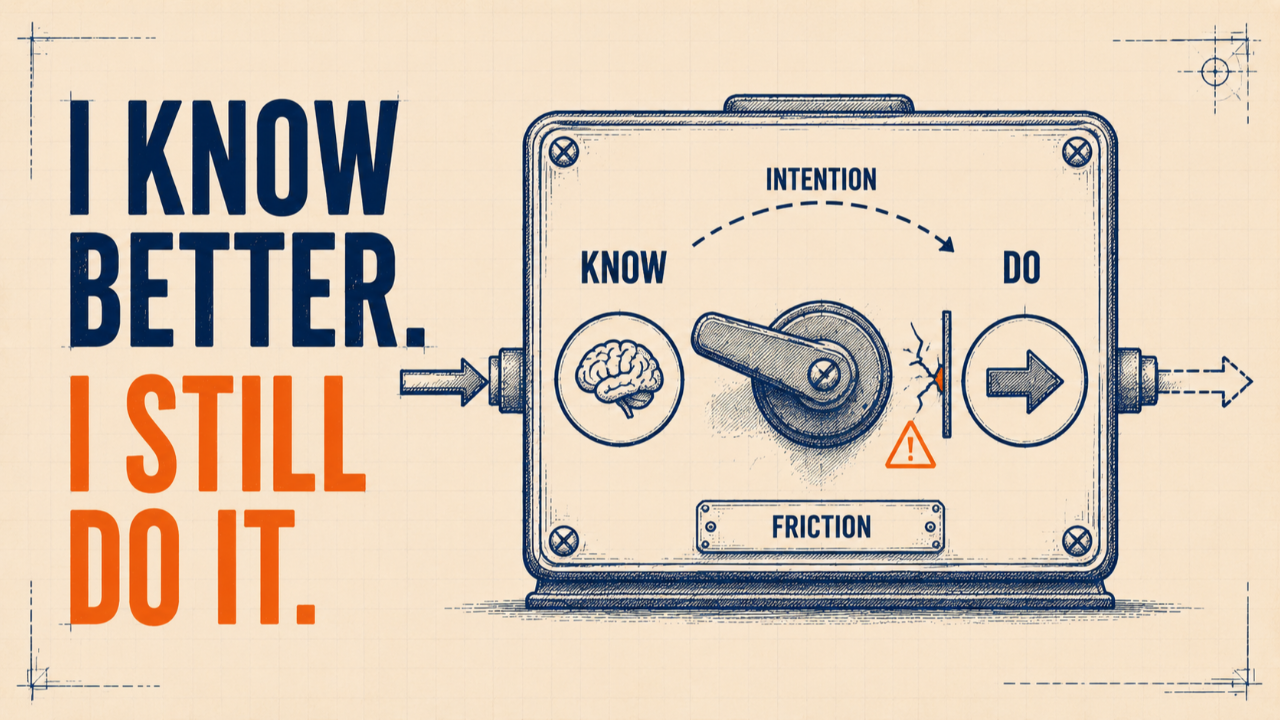
By Gwen Bach, MSc Applied Neuroscience
Published 16 August 2026
Short answer: Knowing what to do gives you an intention, but intention still has to survive stress, cognitive overload, existing habits, practical barriers and changing motivation. When the behaviour you intend to do requires effort while an old response is familiar, immediately available and strongly cued, the old behaviour can win even when your goal genuinely matters. The problem is often not knowledge, but turning intention into action under real-world conditions.
You know what you need to do to get to where you want to be… but somehow you don’t get yourself to do the work consistently.
-
You want to get fit but end up watching Netflix and eating pizza after work.
-
You want to write your book but don’t get yourself to keep on writing.
-
Maybe you want to start this business you’ve been dreaming of for years… but don’t really get started seriously.
In all of these cases knowledge is not the missing piece, taking the needed action is. It makes no logical sense… so why? You are smart and yet you keep repeating this frustrating pattern. So why on earth don’t you do what you need to do?
It is painful, frustrating and it can eat your self-respect and diminish hope.
Mechanism
Why isn't knowing enough?
You see, intention is only the first step.
Research shows that a clear intention often fails to become consistent action because of the intention-behaviour gap. The size of that gap does not depend only on how strongly you want something. It is also shaped by the conditions in which you have to act: stress, cognitive overload, existing habits, practical barriers and shifting motivation (Faries, 2016; Jekauc et al., 2026; Sheeran & Webb, 2016).
You can want something strongly and still not get yourself to do it. Ask me, I wanted to create videos for years and did not get myself properly started for a very long time.
Think about what this looks like in real life.
You decide on Sunday evening that you will exercise after work on Monday. The intention is real and you really mean it because your pants are getting tight and your energy feels low.
But then it’s Monday at 6 p.m. and you have spent the day working, answering emails, making decisions and being interrupted. Maybe a meeting became difficult and went longer. Now you are hungry. Your phone is next to you. The sofa feels so much more comfy.
Sitting down and watching something is a routine you have repeated hundreds of times. After all, it’s just an exception and you deserved it, the day was stressful and you feel that twitch in your back… you don’t want to aggravate that, right?
What has to happen between intention and action?
Carrying out an intention requires more than remembering what you wanted.
You need to keep the goal active, work out the next step, inhibit competing responses and adjust when circumstances are not ideal. Stress and cognitive overload can interfere with exactly these processes (Brown et al., 2020; Girotti et al., 2024; Quaedflieg et al., 2019).
Existing behavioural patterns matter too.
Repeated behaviours become linked to the situations in which they happen.
If coming home tired normally leads to the sofa and takeout, or uncertainty about work leads to doomscrolling on your phone, those responses already have a history. Familiar cues can make the old behaviour easier to start than the new one you decided on earlier (Adriaanse et al., 2011; Armitage, 2016; Webb et al., 2009).
This does not mean stress simply switches the brain into “automatic habit mode”. Smeets and colleagues (2023) show that the picture is more nuanced.
When the intended action requires planning, inhibition and effort — you want to go to the gym and cook a healthy dinner — while another response is familiar, immediately available and strongly cued — order takeout and watch Netflix — the gym is at a disadvantage.
Why does modern life make the gap bigger?
And our modern life adds to that disadvantage.
Work overload, digital demands and information overload increase the cognitive and emotional load under which behaviour has to happen (Junça Silva et al., 2024; Tyrväinen et al., 2025).
Ordinary friction does the same: your meeting runs late, the gym is crowded, your child needs picking up, that unloved task takes much longer than you expected (Fink et al., 2021; Nguyen et al., 2022).
And intentions themselves change. What felt important when you decided can feel less compelling when it is time to act (Jekauc et al., 2025; Rhodes & Dickau, 2013).
We’ve all experienced that, be it the gym, cleaning out the garage or working on this project… you know which one I mean.
Knowing gives you an intention. But that intention still has to survive contact with your mental state, your existing behavioural patterns and the messy, chaotic conditions of real life.
Evidence
How well do intentions predict behaviour?
The intention-behaviour gap is well established.
Across physical activity, diet and other health behaviours, people frequently form intentions that are not fully translated into action (Faries, 2016; Feil et al., 2023; Jekauc et al., 2026; Sheeran & Webb, 2016).
Intentions, however, are not useless. People who intend to do something are more likely to do it than people who do not, but intention alone is an imperfect predictor of what actually happens later (Sheeran & Webb, 2016).
So the scientific conclusion is not that intentions do not matter. It is that wanting or intending to do something is only one part of successful action.
Do stress and cognitive overload matter?
There is evidence that the conditions in which action has to happen affect goal-directed behaviour.
Acute stress can disrupt flexible, goal-directed behaviour, although individual differences matter (Brown et al., 2020; Quaedflieg et al., 2019). Chronic stress is also associated with broader effects on cognitive functions involved in effective goal pursuit (Girotti et al., 2024).
Modern work and digital environments can add further load. Work overload is associated with emotional exhaustion, while social media overload has been linked to a range of adverse outcomes in meta-analytic research (Junça Silva et al., 2024; Tyrväinen et al., 2025).
That does not mean every busy day destroys your ability to act deliberately. It means that an intention has to be carried out under conditions that can make flexible, effortful action more difficult.
What role do existing habits play?
Strongly established behaviours can compete with new intentions, particularly when the old response is tied to familiar cues (Adriaanse et al., 2009, 2011; Armitage, 2016; Webb et al., 2009).
And this competition is not fixed. Research on implementation intentions suggests that linking a specific cue to a planned response can improve the translation of intentions into action and can help people respond differently when an established behaviour would normally take over (Adriaanse et al., 2011; Gollwitzer, 1999; Gollwitzer & Sheeran, 2006; Wieber et al., 2015).
So “I just need more motivation” is a very incomplete explanation.
The gap appears because an intention still has to make it through a normal day. Your energy and focus go up and down, stress comes and goes, familiar easy behaviours are right there waiting, something unexpected gets in the way, and the thing that felt so important on Sunday can feel a lot less urgent by Monday evening.
Application
Once you see the problem this way, the practical question changes.
Instead of asking:
“How do I make myself want this more?”
ask:
“What happens between deciding to do this and the moment I actually have to do it?”
You cannot solve an action problem only at the level of intention. The real work happens in those few moments when the old behaviour is about to win.
Interrupt the moment before the old behaviour wins
Here is a short writing exercise I have used myself and with clients.
The rule is simple: before you do the thing you usually regret — watching Netflix, eating the chocolate, scrolling, opening the inbox instead of the document — take two minutes and write the answers to these questions.
-
What do I feel like doing right now?
-
What would be the better choice that actually moves me in the direction I want to go?
-
What do I really feel like doing?
-
If I look back from tomorrow, what would I have wanted myself to decide now?
-
If I look back from a month from now, what would I have wanted myself to decide in this moment?
Most of the time the first and third answers are the same: Netflix, the chocolate, the scroll.
The second answer is usually the goal-directed one.
The last two questions often shift something because they force you to hear from the version of you who has to live with the consequences. Instead of quietly dumping the cost onto your future self, you let that future self speak for a moment.
You do not have to forbid yourself anything.
You just have to write the answers first.
That short pause gives you a chance to interrupt the automatic pull before you follow it.
Plan for the moment where you normally get derailed
Once you can see the pattern more clearly, the next step is to plan for it.
Implementation intentions turn a vague goal into a concrete response linked to a particular situation: if X happens, then I will do Y (Gollwitzer, 1999; Gollwitzer & Sheeran, 2006; Wieber et al., 2015).
Planning also becomes more useful when it anticipates the conditions under which the intention normally breaks down rather than assuming everything will go according to plan (Sniehotta et al., 2005).
For example:
If I finish breakfast, then I will open the document and write for 20 minutes before I open my email.
If I notice myself reaching for my phone while I am supposed to be writing, then I will put it down and write for another five minutes before I decide whether to stop.
If my meeting finishes too late for the gym, then I will walk the dog for 20 minutes instead.
The point is not to make a prettier plan.
It is to decide what you will do at the point where your current plan normally falls apart.
Make the intended behaviour require less thinking
If your life already feels overloaded, also make the intended behaviour require less thinking at the moment of action.
Prepare the clothes the night before.
Open the document before the session starts.
Put the phone somewhere else.
Decide the first task before you sit down.
Sounds generic and cheesy, but it actually does something: it reduces the number of decisions and competing responses you have to deal with in the critical moment.
The aim is not a perfect environment or the elimination of every difficult feeling.
It is to stop making your intended behaviour depend on having exactly the right level of motivation, attention and energy at exactly the right moment.
Knowing is rarely the problem for any of us.
The work is in building the small, concrete structures that let intention survive contact with habit, distraction, limited control and the ordinary friction of daily life.
References
Adriaanse, M. A., de Ridder, D. T. D., & de Wit, J. B. F. (2009). Finding the critical cue: Implementation intentions to change one’s diet work best when tailored to personally relevant reasons for unhealthy eating. Personality and Social Psychology Bulletin, 35(1), 60–71. https://doi.org/10.1177/0146167208325612
Adriaanse, M. A., Gollwitzer, P. M., de Ridder, D. T. D., de Wit, J. B. F., & Kroese, F. M. (2011). Breaking habits with implementation intentions: A test of underlying processes. Personality and Social Psychology Bulletin, 37(4), 502–513. https://doi.org/10.1177/0146167211399102
Armitage, C. J. (2016). Evidence that implementation intentions can overcome the effects of smoking habits. Health Psychology, 35(9), 935–943. https://doi.org/10.1037/hea0000344
Brown, T. I., Gagnon, S. A., & Wagner, A. D. (2020). Stress disrupts human hippocampal-prefrontal function during prospective spatial navigation and hinders flexible behavior. Current Biology, 30(10), 1821–1833.e8. https://doi.org/10.1016/j.cub.2020.03.006
Faries, M. D. (2016). Why we don’t “just do it”: Understanding the intention-behavior gap in lifestyle medicine. American Journal of Lifestyle Medicine, 10(5), 322–329. https://doi.org/10.1177/1559827616638017
Feil, K., Fritsch, J., & Rhodes, R. E. (2023). The intention-behaviour gap in physical activity: A systematic review and meta-analysis of the action control framework. British Journal of Sports Medicine, 57(19), 1265–1271. https://doi.org/10.1136/bjsports-2022-106640
Fink, L., Strassner, C., & Ploeger, A. (2021). Exploring external factors affecting the intention-behavior gap when trying to adopt a sustainable diet: A think aloud study. Frontiers in Nutrition, 8, 511412. https://doi.org/10.3389/fnut.2021.511412
Girotti, M., Bulin, S. E., & Carreno, F. R. (2024). Effects of chronic stress on cognitive function – From neurobiology to intervention. Neurobiology of Stress, 33, 100670. https://doi.org/10.1016/j.ynstr.2024.100670
Gollwitzer, P. M. (1999). Implementation intentions: Strong effects of simple plans. American Psychologist, 54(7), 493–503. https://doi.org/10.1037/0003-066X.54.7.493
Gollwitzer, P. M., & Sheeran, P. (2006). Implementation intentions and goal achievement: A meta-analysis of effects and processes. Advances in Experimental Social Psychology, 38, 69–119. https://doi.org/10.1016/S0065-2601(06)38002-1
Jekauc, D., Voelkle, M. C., Giurgiu, M., & Nigg, C. R. (2025). Unveiling the multidimensional nature of the intention–behavior gap: Dynamics of intentions and behaviors. European Journal of Health Psychology, 32(1), 34–50. https://doi.org/10.1027/2512-8442/a000162
Jekauc, D., Voelkle, M. C., Sniehotta, F. F., & Nigg, C. R. (2026). Beyond the cross-section: Rethinking the intention–behaviour gap through a conceptual and methodological lens. British Journal of Health Psychology, 31(1), e70046. https://doi.org/10.1111/bjhp.70046
Junça Silva, A., Almeida, A., & Rebelo, C. (2024). The effect of telework on emotional exhaustion and task performance via work overload: The moderating role of self-leadership. International Journal of Manpower, 45(2), 398–421. https://doi.org/10.1108/IJM-08-2022-0352
Nguyen, C., Faulkner, M., Yang, S., Williams, J., & Tong, L. (2022). Mind the gap: Understanding the gap between intentions and behaviour in the charity context. Journal of Business Research, 148, 216–224. https://doi.org/10.1016/j.jbusres.2022.04.044
Quaedflieg, C. W. E. M., Stoffregen, H., Sebalo, I., & Smeets, T. (2019). Stress-induced impairment in goal-directed instrumental behaviour is moderated by baseline working memory. Neurobiology of Learning and Memory, 158, 42–49. https://doi.org/10.1016/j.nlm.2019.01.010
Rhodes, R. E., & Dickau, L. (2013). Moderators of the intention-behaviour relationship in the physical activity domain: A systematic review. British Journal of Sports Medicine, 47(4), 215–225. https://doi.org/10.1136/bjsports-2011-090411
Sheeran, P., & Webb, T. L. (2016). The intention–behavior gap. Social and Personality Psychology Compass, 10(9), 503–518. https://doi.org/10.1111/spc3.12265
Smeets, T., Ashton, S. M., Roelands, S. J. A. A., & Quaedflieg, C. W. E. M. (2023). Does stress consistently favor habits over goal-directed behaviors? Data from two preregistered exact replication studies. Neurobiology of Stress, 23, 100528. https://doi.org/10.1016/j.ynstr.2023.100528
Sniehotta, F. F., Scholz, U., & Schwarzer, R. (2005). Bridging the intention–behaviour gap: Planning, self-efficacy, and action control in the adoption and maintenance of physical exercise. Psychology & Health, 20(2), 143–160. https://doi.org/10.1080/08870440512331317670
Tyrväinen, O., Pirkkalainen, H., Salo, M., & Karjaluoto, H. (2025). Overloaded yet addicted? A meta-analysis of the outcomes of social media overload. Telematics and Informatics, 98, 102247. https://doi.org/10.1016/j.tele.2025.102247
Webb, T. L., Sheeran, P., & Luszczynska, A. (2009). Planning to break unwanted habits: Habit strength moderates implementation intention effects on behaviour change. British Journal of Social Psychology, 48(3), 507–523. https://doi.org/10.1348/014466608X370591
Wieber, F., Thürmer, J. L., & Gollwitzer, P. M. (2015). Promoting the translation of intentions into action by implementation intentions: Behavioral effects and physiological correlates. Frontiers in Human Neuroscience, 9, 395. https://doi.org/10.3389/fnhum.2015.00395