
Why do old habits come back in certain situations?
Aug 21, 2026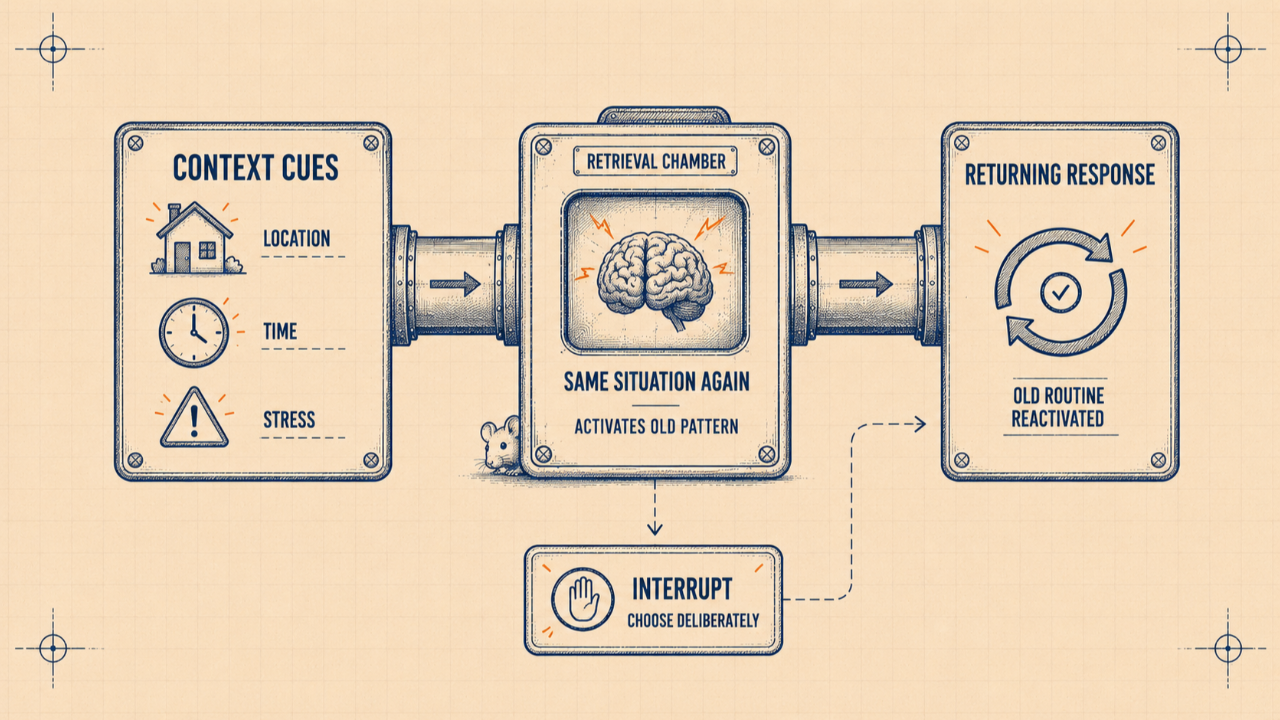
By Gwen Bach, MSc Applied Neuroscience
Published 21 August 2026
Short answer: Old habits often come back in certain situations because habits are learned in context. Places, times, people, routines and even internal states can become cues that automatically activate a previously learned response. Changing your intentions does not necessarily remove that cue-response association. When the old context returns — particularly when you are tired or stressed — the old behaviour can therefore become surprisingly easy to slip back into (Gardner et al., 2024; Neal et al., 2006).
You can go for weeks doing really well with something and start thinking: Oh, excellent. Apparently I am a changed woman.
Then you go home for Christmas, have one horrendous week at work, travel, see a particular person, sit down in that chair after dinner — whatever your version is — and suddenly there you are doing the very thing you thought you had stopped doing.
You start checking your phone every five minutes again. You stop exercising. You eat differently. You disappear into the news instead of starting work. Perhaps you haven't smoked for months and suddenly the urge appears when you are standing outside a pub with old friends.
And because we tend to think of behaviour change as something that happens inside us, the return of the behaviour can feel like evidence that nothing really changed.
Except behaviour is much more dependent on context than most of us realise.
A habit develops partly because a behaviour has repeatedly occurred in connection with particular cues. Eventually, encountering those cues can automatically activate an impulse or tendency to perform the behaviour again (Gardner et al., 2024; Neal et al., 2006).
So why do old habits come back in some situations, even when you genuinely want to behave differently?
Mechanism
Why can a familiar situation bring an old behaviour back?
When you repeatedly do something under similar circumstances, parts of that situation can become associated with the behaviour.
The cue might be obvious. You walk through the front door and put your keys in the same place. You get into the car and fasten your seatbelt. You brush your teeth and reach for the floss.
But behavioural cues are not limited to physical objects.
They can include a location, time of day, another person, the activity immediately preceding the behaviour or a particular sequence of events. Research also suggests that moods and other internal states can sometimes become part of the cueing context (Phipps et al., 2024).
Through repetition, encountering that context can begin to activate the corresponding behaviour with less need for deliberate thought.
This is one reason habits are useful. Imagine consciously deciding every morning exactly how to brush your teeth, make coffee, get dressed, drive to work and operate every familiar piece of equipment you encounter. Life would be exhausting.
Habitual control reduces some of that cognitive work.
The difficulty appears when the response your context is cueing is no longer the response you want.
You may now have an entirely different goal, but when you encounter the familiar cue, the old action can still become highly accessible.
Why doesn't deciding to change remove the old habit?
Because changing your intention and changing a learned cue-response relationship are not the same process.
You can decide today that you are going to stop checking your phone while you work. That changes your current goal.
It does not instantly erase the history of repeatedly reaching for your phone whenever you encounter the cues that have accompanied that behaviour for the past five years.
This is where it is useful to be precise about what we mean by a habit.
A recent review by Gardner and colleagues (2024) describes habit as a cognitive process in which encountering a contextual cue automatically activates an impulse to perform a response that has previously been repeated in connection with that cue.
The impulse does not guarantee the behaviour.
You can override it. Other goals can win. The environment can make the behaviour impossible. You can notice what is happening and choose something else.
But the old response has effectively been given a head start.
And this helps explain something that otherwise feels very strange: you can sincerely want one thing and still find yourself beginning to do another.
Why does the old habit sometimes disappear when our circumstances change?
One of the clearest demonstrations of the importance of context comes from research by Wood, Tam and Witt (2005).
They studied university students whose circumstances changed when they transferred university. Habits such as exercising, watching television and reading the newspaper were disrupted when relevant features of the students' normal performance contexts changed.
Interestingly, when circumstances disrupted the usual cues, behaviour became more responsive to people's current intentions.
That matters.
We often assume that moving house, starting a new job, travelling or changing routine makes behaviour change harder because everything is unsettled. Sometimes it does.
But disruption also removes some of the environmental machinery that has been quietly producing your old behaviour.
You suddenly have to decide again.
Unfortunately, the opposite can happen when you return.
Walk back into the old environment and the old cues are waiting for you.
Why can stress make an old pattern more likely?
Stress adds another complication.
Some experimental research suggests that acute stress can reduce sensitivity to outcomes and shift behaviour towards previously learned or response-based patterns. In a well-known human experiment, Schwabe and Wolf (2009) found that stressed participants continued responding despite one of the outcomes having been devalued, whereas control participants adapted their behaviour.
There is also broader evidence that acute stress can impair aspects of executive functioning, including working memory and cognitive flexibility, although effects vary according to the task and circumstances (Shields et al., 2016).
In ordinary life, that could matter because deliberately doing something different often requires more cognitive control than simply following the familiar response.
After eight hours of sleep, a quiet morning and a manageable workload, you may catch yourself reaching for your phone and put it back down.
At the end of a horrible day when seventeen things have gone wrong, perhaps you don't.
But there is an important qualification here: stress does not inevitably put the brain into “habit mode”.
A 2025 study by Zwosta and colleagues failed to find the predicted general shift towards habitual and away from goal-directed action following acute stress. Other recent findings also suggest that goal-directed planning can sometimes remain intact under stress.
So “stress makes you habitual” is too simple.
A better conclusion is that stress can create conditions in which deliberate control becomes harder and well-learned responses may gain an advantage — but the effect depends on the person, task, type of stress and existing learning.
Evidence
Do habits really depend that much on context?
There is considerable evidence that they do.
Neal, Wood and Quinn (2006) describe habits as responses that can be automatically activated by contextual cues associated with previous performance. Later work has continued to support the importance of repeated cue-behaviour pairings.
For example, Phipps and colleagues (2024) found that consistency in cues such as time, preceding activity and mood was associated with stronger relationships between previous physical activity and habit.
Experimental and longitudinal habit-formation studies similarly suggest that repeating a behaviour in response to a consistent cue helps automaticity develop (Keller et al., 2021).
There is a nice symmetry here.
The mechanism that can bring an old habit back is also one of the mechanisms we can use to build a new one.
A cue does not care whether the behaviour attached to it is the one you are trying to stop or the one you are trying to build.
Does an old habit ever really disappear?
This is harder to answer than popular discussions of habits sometimes suggest.
Real-world habits are not little programmes stored in one neat part of the brain that can simply be deleted and replaced.
Learning research shows that previously acquired responses can sometimes reappear when the context changes or the original context returns. Much of the detailed work on renewal and reinstatement comes from conditioning and animal research, so we should be careful about directly translating every finding into everyday human behaviour.
But it supports a broader point that fits human habit research: new learning does not necessarily destroy every influence of previous learning.
Gardner et al. (2024) therefore argue that phrases such as “breaking a habit” can be misleading. Behaviour can stop for several reasons even while the underlying cue-driven tendency remains.
That is why lack of behaviour is not necessarily proof that the cue-response relationship has vanished.
Sometimes the circumstances simply haven't activated it recently.
Does wanting the new behaviour still matter?
Yes.
Habit research does not show that intention becomes irrelevant once a habit exists.
Habit and goal-directed behaviour are better thought of as interacting influences. Sometimes habit dominates. Sometimes your current goal does. Sometimes the environment makes one response much easier than the other.
This is also why behaviour change strategies that rely purely on “wanting it enough” tend to be unreliable for repeated behaviours.
Your intention has to compete repeatedly with a response that may already be efficiently cued by the situation.
It is much more useful to change what happens when the cue occurs.
And this brings us to the practical part.
Application
Can you use the cue to build the new behaviour instead?
One of the simplest ways I know of doing this comes from behavioural scientist BJ Fogg and his Tiny Habits method.
Fogg's broader Behaviour Model proposes that behaviour occurs when three things come together at the same moment: motivation, ability and a prompt (Fogg, 2009).
Tiny Habits turns that idea into something very practical.
Instead of beginning with:
I need to become a person who exercises every day.
you find a reliable moment that already exists in your life and attach an extremely small behaviour to it:
After I [existing behaviour], I will [tiny new behaviour].
Fogg calls the existing behaviour the anchor.
His wonderfully memorable example is:
After I pee, I will do two push-ups.
The important number there is two.
You are allowed to do twenty. But the requirement stays tiny.
The point is to make the action so easy that you do not require a particularly enthusiastic version of yourself to turn up every day. Fogg's method also includes an immediate “celebration” — some small way of creating a feeling of success after the behaviour (Fogg, 2020).
I would be slightly more cautious than some popular descriptions about making grand neuroscientific claims for the celebration part. The stronger research base here concerns consistent cues, repetition and making the target behaviour sufficiently easy to perform.
And I know the push-up example rather well because I copied it.
After watching Fogg explain Tiny Habits, I started doing two push-ups every time I went to the bathroom.
At first, obviously, I had to remember.
Then one night I woke up at about one in the morning to go to the loo. I was half asleep, went to the bathroom…and found myself on the floor doing my two push-ups.
At one o'clock in the morning.
Nobody watching. No motivational speech. Certainly no great enthusiasm for personal development.
The cue had started doing some of the work.
And then I travelled.
I went to the bathroom on a German train, looked at the floor and there was absolutely no chance I was putting my hands anywhere near it.
Push-ups cancelled.
And the habit disappeared.
Which, in retrospect, was an almost embarrassingly good lesson in contextual behaviour.
The behaviour I thought I had “built” depended partly on a particular relationship between a reliable cue and a response that was easy to perform in that environment. Change the environment enough and the recipe no longer worked.
Fogg himself has talked about adapting the response in public bathrooms — doing something such as squats rather than getting down on the floor.
And that gives us a useful addition when we are trying to replace an old behaviour.
How do you use this for an unwanted habit?
Start with the situation, rather than the grand behaviour-change goal.
For a few days, notice where the old behaviour reliably appears.
Ask:
What happens immediately before I do it?
Look for something concrete:
- Where am I?
- What time is it?
- Who am I with?
- What have I just done?
- What am I feeling?
- What object or device is in front of me?
You are looking for the most reliable anchor moment.
Then decide what tiny behaviour you would rather attach to that moment.
For example, suppose your pattern is opening your laptop in the morning and immediately disappearing into email, news or whatever else is more attractive than the piece of work you actually intended to do.
The intervention does not have to be:
From tomorrow I will work on my important project for two uninterrupted hours before checking anything else.
That requires quite a lot from tomorrow's version of you.
Your Tiny Habit might instead be:
After I open my laptop, I will open the document I need to work on and write one sentence.
One sentence.
You can write for an hour if you get going.
But one sentence counts.
Or perhaps you always reach for something sweet when you put the kettle on in the afternoon.
Rather than trying to spend the next six months heroically resisting the kitchen, identify that moment and build a different tiny response into it.
The exact replacement matters less than getting the behavioural design right:
reliable cue → extremely easy response → repetition
And if you know that the cue occurs in very different environments, design for that before the German-train-toilet moment arrives.
What is the version you can still do when you are travelling, busy, tired or somewhere the original response makes no sense?
The goal is not to create a perfect streak.
You are trying to make the new response increasingly available in the situation where the old response normally wins.
What should you do when an old habit suddenly comes back?
First, get curious about the context.
Instead of immediately concluding that all your progress has disappeared, ask:
What is here now that wasn't there before?
Perhaps you are back in an old environment.
Perhaps you are seeing particular people.
Perhaps your routine changed.
Perhaps you are under considerably more pressure.
Perhaps the behaviour has always occurred after a particular event and you had simply stopped encountering that event for a while.
That information is useful because it tells you where the behaviour is being organised.
Then you can work at the level where the problem is actually occurring.
Change the cue if you can.
Change the environment.
Or use the cue deliberately and attach a tiny competing response to it.
Because lasting behaviour change is rarely just a matter of deciding, once and for all, that you are now the sort of person who behaves differently.
Very often, you also have to teach the old situations something new.
References
Fogg, B. J. (2009). A behavior model for persuasive design. Proceedings of the 4th International Conference on Persuasive Technology, Article 40. https://doi.org/10.1145/1541948.1541999
Fogg, B. J. (2020). Tiny habits: The small changes that change everything. Houghton Mifflin Harcourt.
Gardner, B., Rebar, A. L., de Wit, S., & Lally, P. (2024). What is habit and how can it be used to change real-world behaviour? Narrowing the theory-reality gap. Social and Personality Psychology Compass, 18(6), e12975. https://doi.org/10.1111/spc3.12975
Keller, J., Kwasnicka, D., Klaiber, P., Sichert, L., Lally, P., & Fleig, L. (2021). Habit formation following routine-based versus time-based cue planning: A randomized controlled trial. British Journal of Health Psychology, 26(3), 807–824. https://doi.org/10.1111/bjhp.12504
Neal, D. T., Wood, W., & Quinn, J. M. (2006). Habits—A repeat performance. Current Directions in Psychological Science, 15(4), 198–202. https://doi.org/10.1111/j.1467-8721.2006.00435.x
Phipps, D. J., Hagger, M. S., Mejia, D., & Hamilton, K. (2024). Testing the effect of cue consistency on the past behavior–habit–physical activity relationship. Behavioral Sciences, 14(6), 445. https://doi.org/10.3390/bs14060445
Schwabe, L., & Wolf, O. T. (2009). Stress prompts habit behavior in humans. The Journal of Neuroscience, 29(22), 7191–7198. https://doi.org/10.1523/JNEUROSCI.0979-09.2009
Shields, G. S., Sazma, M. A., & Yonelinas, A. P. (2016). The effects of acute stress on core executive functions: A meta-analysis and comparison with cortisol. Neuroscience & Biobehavioral Reviews, 68, 651–668. https://doi.org/10.1016/j.neubiorev.2016.06.038
Wood, W., Tam, L., & Witt, M. G. (2005). Changing circumstances, disrupting habits. Journal of Personality and Social Psychology, 88(6), 918–933. https://doi.org/10.1037/0022-3514.88.6.918
Zwosta, K., Karcz, T., Möschl, M., Walser, M., Goschke, T., Ruge, H., & Wolfensteller, U. (2025). No evidence for increased habitual or decreased goal-directed action control after acute stress. PLOS ONE, 20(9), e0327807. https://doi.org/10.1371/journal.pone.0327807