
Why does everything feel harder when I’m overwhelmed?
Aug 18, 2026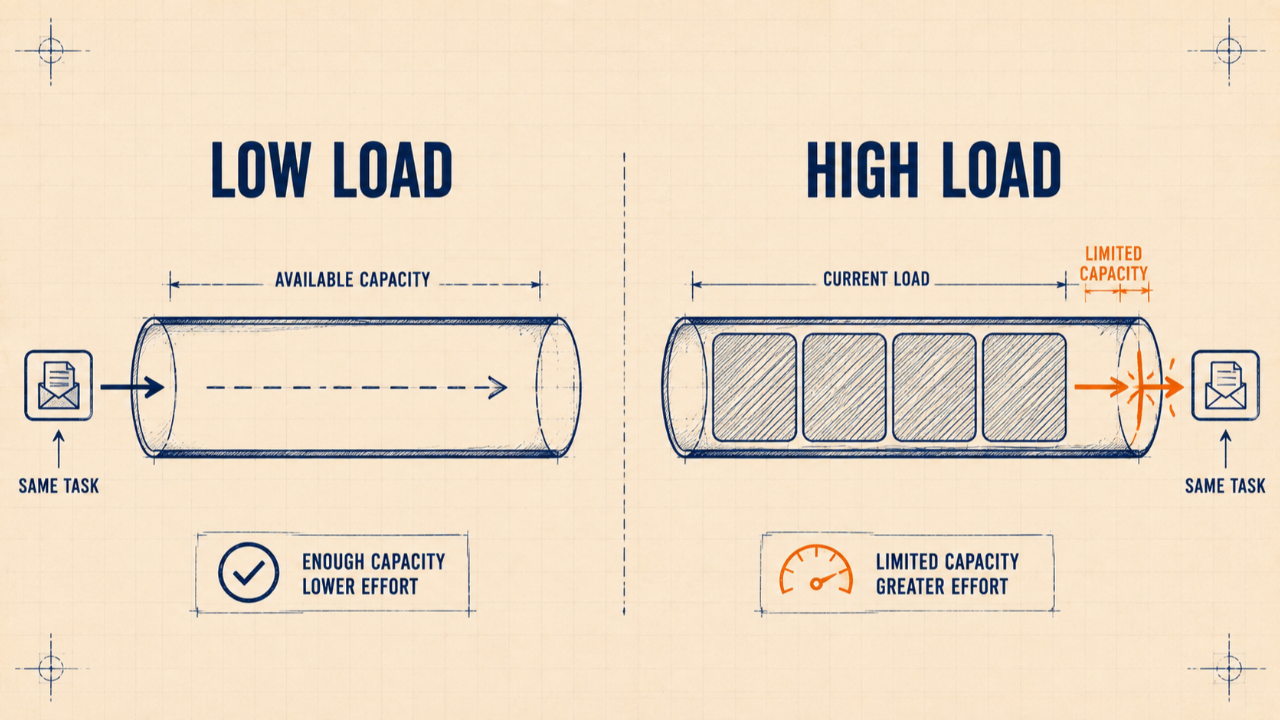
By Gwen Bach, MSc Applied Neuroscience
Published 18 August 2026
Short answer: When you are overwhelmed, part of your limited cognitive capacity is already occupied by competing demands, worries, decisions and unfinished tasks. That leaves fewer resources available for attention, working memory and executive control. Stress can add to this load, while cognitively demanding tasks can also feel more effortful. As a result, things you would normally manage quite easily can suddenly require much more work.
You know those days when nothing you have to do is particularly difficult, yet somehow all of it feels so hard, like an uphill battle you can’t win?
You need to answer a few emails. Make and accept some appointments. Finish the thing you started yesterday. Decide what to cook for dinner. Send out a document. Go to the supermarket. None of these would normally trouble you.
But now the email sits there unanswered because apparently finding six sensible sentences has become a major intellectual undertaking. You walk into the kitchen and forget what you went there for. Someone asks you a perfectly reasonable question and you wonder why people are always so much trouble.
Unfortunately, I know this state rather well.
One version for me starts with having too much to do and too little time. Then I remember three other things while doing the first one, make more tea, look at something on my phone, worry about the work I am not doing while looking at my phone, and eventually the fact that I have achieved very little becomes another thing to ruminate about and beat myself up over.
At some point even a small task starts to feel ginormous.
So why does that happen?
Mechanism
Why does mental overload make ordinary tasks harder?
Diving into the research a while back, I was actually quite relieved to find out that it’s not just me feeling this way. It is basically part of the human condition. So let’s look at what is happening underneath.
The first thing to understand is that the brain does not deal with each new task in isolation.
Working memory is what allows us to hold a small amount of information in mind and do something with it. You use it when you follow instructions, organise a thought, write an email, solve a problem or try to remember what you were doing before someone interrupted you.
Executive control helps you keep your attention where you want it, ignore distractions, switch between things and stop yourself from reacting to every new thing that pops up.
Unfortunately, both are limited.
Research shows that the more information we are already trying to keep in working memory, the harder it becomes to control our attention (Hester & Garavan, 2005). Imagine trying to keep a ten-digit number in your head while playing a difficult game of chess. Most of us would be pretty rubbish at one of the two.
And worry takes up space too. Anxiety is reliably associated with poorer working-memory performance, although how much depends on the person and the task (Moran, 2016).
That is basically what overwhelm does. There is already a lot going on before the next thing even arrives.
You may physically have one document open in front of you, but at the same time you are remembering that you have to call the doctor, wondering whether you handled yesterday’s meeting badly, trying not to forget something your daughter needs, thinking about the deadline on Thursday and periodically noticing the six unread messages on your phone.
Those things do not all have to be conscious at precisely the same moment to matter. Unfinished goals, worries and competing demands keep returning to attention and requiring processing.
So the report may not have become objectively more complicated. You are trying to write it while the same limited system is also dealing with everything else.
Stress can add another layer. Acute and subjective stress have been associated with changes in working-memory performance and the neural systems involved in it (Luettgau et al., 2018; Sandi, 2013).
This does not mean that stress simply shuts down the prefrontal cortex or that being overwhelmed makes rational thought impossible. Those are much stronger claims than the evidence supports.
The amount of cognitive control available for one task depends partly on how much else the system is already managing.
Why does everything also feel more effortful?
There’s another part of overwhelm that, for me, explains really well why everything suddenly feels like such hard work.
Mental effort has a cost.
Some things simply need more concentration than others. Writing something difficult, making a decision, trying to hold several things in mind at once — all of that takes effort, and we can actually feel that difference (Bambrah et al., 2019).
When cognitive load goes up, the body also reacts. Studies have found changes in physiological arousal as mental demands increase, even in healthy adults (Portnova et al., 2023).
And I think this is the bit that is easy to miss: there is a difference between still being able to do something and how much it is costing you to do it.
You may still finish the presentation. You may still get through the meeting, answer the important email, make dinner and sort out whatever else needs sorting.
But instead of taking, say, 20% of your available brainpower, it suddenly feels like it takes 70%.
You have to work much harder to stay focused, not pick up your phone, remember where you were after an interruption and make all the little decisions the task requires.
Which is also why people can look perfectly functional from the outside while feeling completely wrung out.
And once enough things start feeling that expensive, avoiding them becomes very tempting.
Reading the news, making tea, reorganising something completely irrelevant or scrolling for ten minutes suddenly feels much easier than figuring out how to restructure the proposal.
Of course, the proposal is still there afterwards.
Evidence
How strong is the link between overload and cognitive performance?
There is good evidence that when working memory is already busy, controlling attention gets harder.
Hester and Garavan (2005), for example, found that as working-memory demands increased, people became worse at filtering out irrelevant information. Moran’s (2016) review found a similar pattern with anxiety: the more anxious people were, the more their working memory tended to suffer.
That does not mean anxiety or overwhelm suddenly makes you incapable of thinking. But it does mean that worry, unfinished thoughts and competing demands can take up some of the same limited mental resources you need to concentrate, make decisions and get things done.
Which is a pretty good explanation for why writing one perfectly normal email can suddenly feel like an Olympic event when your head is already full.
Does stress always make us perform worse?
No.
The relationship between stress and cognition is complicated and depends on the stressor, its intensity and duration, the cognitive process being tested and the demands of the task (Sandi, 2013).
There are even studies in which aspects of selective attention or response inhibition improve under particular stress conditions (Chajut & Algom, 2003; Schwabe et al., 2013).
This is one reason I would be cautious with statements such as “stress shuts down your executive brain”.
Sometimes performance is preserved, and the more interesting question for everyday overwhelm is what it takes to preserve it.
If I can still produce exactly the same piece of work but it takes twice the concentration, several restarts and considerably more frustration, looking only at the final performance misses quite a lot of what is happening.
This distinction between performance and strain also matters when people are functioning under high demands for longer periods. Someone can continue getting things done while the cost of doing so keeps increasing. Eventually that becomes difficult to sustain. I’ve seen that happen in others and in myself too.
Application
Once you understand overwhelm as a problem of competing load, “How do I make myself try harder?” becomes very obviously the wrong question to ask.
You are asking an already overloaded control system to provide more control.
So I find it more useful to ask:
What is my brain currently trying to manage — or juggle?
Then get some of the stuff out of it.
1. Empty the mental pile onto paper
Take a piece of paper and write down everything currently demanding some part of your attention.
Not just your official task list. Spill the beans, literally.
Include the things you are trying not to forget, decisions you need to make, conversations you are replaying, practical problems, unfinished work, personal admin and anything else that keeps popping back into your head.
On an overwhelmed day mine might contain things such as:
- finish blog article
- answer email from yesterday
- plan next week’s video
- book doctor’s appointment
- take daughter to dentist
- buy dog food
- reply to a message I have already mentally replied to five times
- figure out why emails on my website are not working
- and the list goes on and on
The aim is not to organise your entire life. You are trying to stop rehearsing the same unfinished things simply because your brain is worried you will forget them.
In other words: free up some working memory.
2. Separate “exists” from “needs attention now”
This is the step I used to skip.
Once everything was written down, I would look at the enormous list and feel wonderfully organised for approximately six seconds before becoming overwhelmed by the list instead.
So go through it and ask:
Does this actually require my attention today?
Something can matter without requiring action right now.
The dentist appointment still exists tomorrow. My kitchen drawer can remain untidy. The decision about the event happening in October probably does not need twenty minutes of thought this very morning.
Move anything that does not require current attention out of the active list.
What we are doing here is reducing competition.
3. Make the remaining task cognitively smaller
“Work on website” is not really an action my brain likes to process because it’s too big and vague.
Neither is:
“Create full workshop plan.”
“Finish complete presentation for conference.”
Each one still requires your brain to decide what to do first.
So clearly define the next small, doable action instead.
“Open the homepage and rewrite the first section.”
“Write the title of page 12 in my conference presentation.”
The task itself may still be large, but you no longer have to solve the whole thing before starting to work on it.
We go from huge and vague to small and clearly defined.
4. Stop adding new input for a while
This part is remarkably easy to sabotage. I’m very good at that.
You reduce your cognitive load, decide what matters, start the task... and then keep email, WhatsApp, Teams, news alerts and 36 browser tabs available in case you miss out on something.
Smart, right?
And then I wonder why I am so scatterbrained.
Every interruption has the potential to introduce another demand, decision or unfinished thought.
So for the period in which you are doing the thing you chose, make it slightly harder for new things to pop up on your radar.
Close the inbox, put your phone away, close the browser tabs and, if another thought pops up, add it to your list rather than acting on it.
Again, we are not aiming for perfection. We are just giving the task we want to get done a better chance of being the only task for a while.
And sometimes the problem really is the workload
There is a limit to what any cognitive strategy can achieve.
If you write everything down and discover that you genuinely have eleven hours of work, four hours available, a sick child at home and three people waiting for decisions from you, the problem is not that your brain needs a better productivity technique.
You simply have too much to do.
At that point something has to move: the deadline, the amount of work, somebody else’s expectation, the standard you are aiming for or who is responsible for doing it.
This matters because discussions about overwhelm can become strangely individualised. We teach people breathing exercises, time management and resilience while leaving the actual amount of work untouched. And we humans are also notoriously bad at estimating how long things will take and how much effort they will require, which means we can quite genuinely plan more into a day than will fit.
The things above can help reduce cognitive load and make work feel more manageable. They cannot make fifteen hours fit into eight.
So if everything suddenly feels much harder than it normally does, look at the load before you start judging yourself for how badly you are coping with it. How much are you trying to keep in mind, how often are you being interrupted, how many decisions are still open, and how much actually needs your attention today?
Sometimes reducing the overload is the intervention.
References
Bambrah, V., Hsu, C.-F., Toplak, M. E., & Eastwood, J. D. (2019). Anticipated, experienced, and remembered subjective effort and discomfort on sustained attention versus working memory tasks. Consciousness and Cognition, 75, 102812. https://doi.org/10.1016/j.concog.2019.102812
Chajut, E., & Algom, D. (2003). Selective attention improves under stress: Implications for theories of social cognition. Journal of Personality and Social Psychology, 85(2), 231–248. https://doi.org/10.1037/0022-3514.85.2.231
Hester, R., & Garavan, H. (2005). Working memory and executive function: The influence of content and load on the control of attention. Memory & Cognition, 33(2), 221–233. https://doi.org/10.3758/BF03195311
Luettgau, L., Schlagenhauf, F., & Sjoerds, Z. (2018). Acute and past subjective stress influence working memory and related neural substrates. Psychoneuroendocrinology, 96, 25–34. https://doi.org/10.1016/j.psyneuen.2018.05.036
Moran, T. P. (2016). Anxiety and working memory capacity: A meta-analysis and narrative review. Psychological Bulletin, 142(8), 831–864. https://doi.org/10.1037/bul0000051
Portnova, G. V., Liaukovich, K. M., Vasilieva, L. N., & Alshanskaia, E. I. (2023). Autonomic and behavioral indicators on increased cognitive loading in healthy volunteers. Neuroscience and Behavioral Physiology. https://doi.org/10.1007/s11055-023-01394-9
Sandi, C. (2013). Stress and cognition. Wiley Interdisciplinary Reviews: Cognitive Science, 4(3), 245–261. https://doi.org/10.1002/wcs.1222
Schwabe, L., Höffken, O., Tegenthoff, M., & Wolf, O. T. (2013). Stress-induced enhancement of response inhibition depends on mineralocorticoid receptor activation. Psychoneuroendocrinology. https://doi.org/10.1016/j.psyneuen.2013.05.001