
Why Smart Leaders Miss Obvious Signals Under Pressure
Jan 19, 2026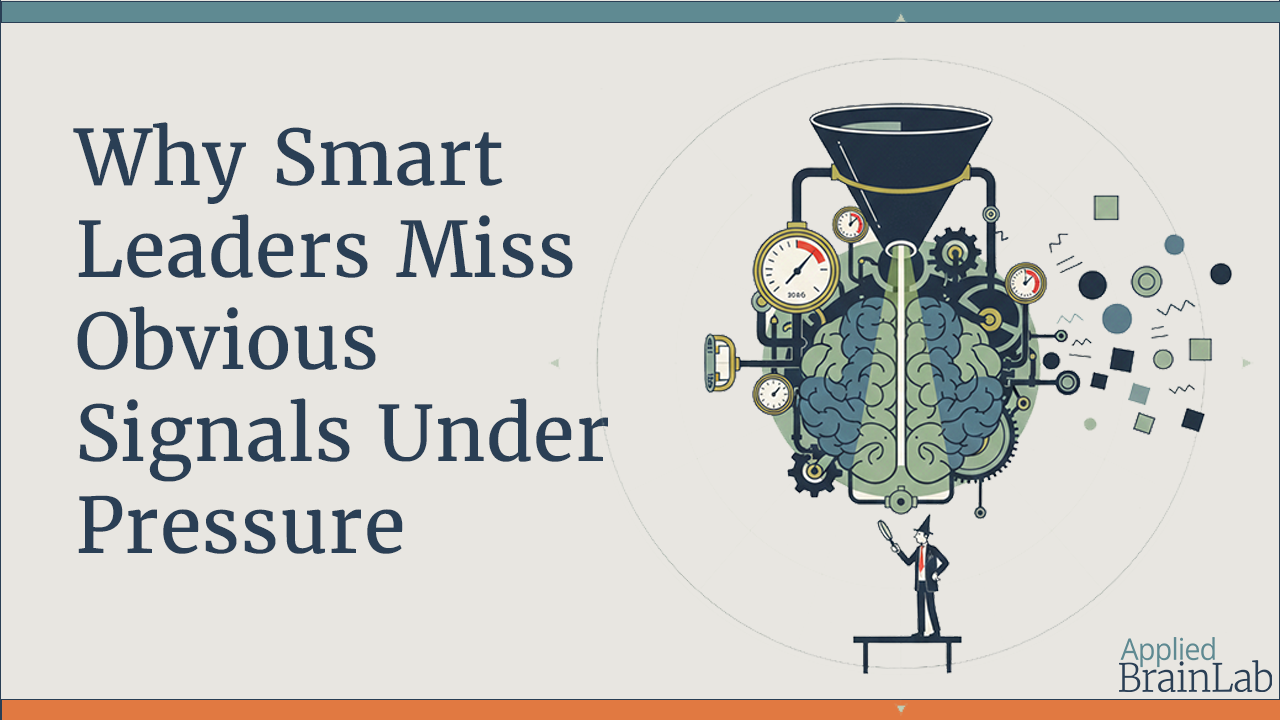
A Diagnostic Look at Attentional Narrowing
If you’ve ever walked away from an important decision and later thought “that should have been obvious”, this article is for you.
Not because you lack intelligence or experience, but because under pressure, attention changes in predictable ways, often without awareness.
This pattern shows up most reliably in people who carry responsibility, operate under time pressure, and are accountable for outcomes rather than tasks. In other words, people who usually make good decisions.
The Moment That Should Have Felt Different
You are in a critical meeting. The data is there. The team is aligned. The decision feels clear.
And yet, weeks later, the flaw is unmistakable.
The signal was present. It was discussed. It may even have been documented. But at the moment of decision, it did not register as decisive.
This is not hindsight bias. It is a known cognitive mechanism called attentional narrowing, and it becomes more active precisely when stakes and pressure increase (Carroll, 2023; Price & LaFiandra, 2017).
Attentional Narrowing: Focus That Becomes Too Narrow
Under stress, attention does not weaken. It contracts.
Time pressure, workload, and urgency reduce environmental scanning and the amount of information gathered before commitment. Attention locks onto a small number of salient cues while peripheral, slower, or less emotionally charged signals fall outside awareness (Carroll, 2023; Hunziker et al., 2013; Samson & Voyer, 2014).
From the inside, this feels like clarity.
From the outside, it often looks like something was missed.
In aviation, this phenomenon is referred to as tunnel vision. Pilots under stress focus on central instruments while missing critical peripheral warnings, not because they are careless, but because their perceptual field has narrowed without conscious awareness (Carroll, 2023).
Executive decision-making shows the same mechanism, just with different inputs.
Less Information, Earlier Commitment
Stress does not only affect what you notice. It affects when you stop looking.
Under pressure, decision-makers consistently gather less information and reach closure earlier. The psychological need to act overrides the impulse to explore further, even when additional information is available (Price & LaFiandra, 2017; Wogalter et al., 1998).
This leads to what researchers call premature closure: decisions made before the decision space has been adequately explored.
In stable environments, this can be efficient.
In volatile or complex environments, it is how critical exceptions are missed.
Why Confidence Often Increases When Decision Quality Drops
One of the most counterintuitive aspects of attentional narrowing is that it often arrives with increased confidence.
When attention narrows, fewer signals compete for integration. Ambiguity decreases. Cognitive conflict drops. Internally, this can feel like decisiveness and certainty.
Research shows that under stress, decision quality can decline while confidence remains unchanged or even increases (Steinrücke, Veldkamp, & de Jong, 2019; Carroll, 2023).
This is why stress-related decision errors are so often recognised only in retrospect.
When certainty rises while informational breadth shrinks, decision risk increases, not decreases.
Where This Shows Up Most Reliably
If you are responsible for complex decisions under pressure, attentional narrowing is not occasional. It is structural.
Strategic Decisions
Under time pressure, attention locks onto deal terms, metrics, or headline indicators. Peripheral signals such as cultural mismatch, execution risk, or second-order effects receive insufficient weight. When outcomes fail, the causes often feel “obvious” in hindsight (Price & LaFiandra, 2017; Dwyer et al., 2026).
Crisis Situations
During crises, attention narrows toward immediate containment. Underlying vulnerabilities remain unaddressed, increasing recurrence risk. Stress accelerates closure and biases attention toward the most salient cues (Wogalter et al., 1998; Wilson & Orlove, 2021).
Team Coordination
In transformation or high-pressure initiatives, stress reduces sensitivity to team signals. Leaders miss early indicators of disengagement, quiet dissent, or fragile alignment, impairing execution and increasing friction (Muhonen et al., 2022; Leder et al., 2015).
If a failure later feels predictable, not surprising, attentional narrowing was likely active at the time of decision.
Why Complex Decisions Are Hit Hardest
Stress does not impair all decisions equally.
Routine or well-practised tasks are relatively resilient. Complex decisions — those requiring integration of multiple information sources, adaptation to novelty, or tolerance of ambiguity — are disproportionately affected.
The reason is simple: these decisions rely on controlled processing, which draws on cognitive resources that stress depletes (Price & LaFiandra, 2017; Dwyer et al., 2026).
This creates a mismatch for senior leaders: the decisions that matter most are the ones most vulnerable to attentional contraction.
The Social Blind Spot
Attentional narrowing is not limited to data.
Stress reduces social attention and sensitivity to others’ signals. Leaders become less responsive to subtle cues of uncertainty, disagreement, or hesitation, impairing coordination and collective sense-making (Muhonen et al., 2022; Leder et al., 2015).
Because leadership decisions rarely involve data alone, this social narrowing carries real downstream cost.
Signs Attentional Narrowing Is Active
You may be operating with narrowed attention if you recognise patterns such as:
-
Decisions that later ignored information that now seems obvious
-
Faster closure on decisions that deserved further exploration
-
Strong confidence paired with incomplete situational review
-
Team members referencing points you do not recall registering
-
Repeated reliance on familiar frameworks despite contextual change
These are not signs of declining ability. They are indicators that cognitive systems are reorganising under pressure (Hunziker et al., 2013; Price & LaFiandra, 2017; Muhonen et al., 2022).
Why “Just Focus More” Makes Things Worse
Attentional narrowing is not a failure of effort or intention. It is an automatic stress adaptation.
In some contexts, trying harder to focus can further increase cognitive load and worsen narrowing (Hunziker et al., 2013).
The more useful question is not whether stress affects attention, but whether decision processes include safeguards that deliberately widen the informational aperture when pressure is highest.
Attentional narrowing is only one of several ways stress alters decision-making under pressure.
For a broader view of how stress reshapes judgment, confidence, and risk evaluation across high-stakes environments, see: Thinking Under Pressure: Why Decision Quality Declines.
A Note on Nuance
There is evidence that stress can enhance selective attention for narrowly defined targets under constrained conditions. However, this benefit is limited and comes at the cost of reduced sensitivity to peripheral information, making it risky in complex decision environments (Kan et al., 2019).
Stress can also increase deliberation in some paradigms, leading to overthinking or indecision without improving decision quality (Amemiya et al., 2020).
These nuances do not alter the dominant conclusion: in complex, high-stakes environments, attentional narrowing is more often a liability than a benefit.
Why This Matters Now
If you are making decisions under sustained pressure, you should assume attentional narrowing is active by default.
Every decision made with contracted awareness carries elevated risk: missed opportunities, underestimated threats, fragile implementation, or second-order effects that were visible but unattended.
If someone you work with is making fast, confident decisions that later unravel, this is often the mechanism at work.
A Structured Starting Point
If you want to understand how your thinking shifts under pressure, including patterns linked to narrowed attention and premature closure, the Default Mode Diagnostic provides a structured starting point.
It is designed to surface how decisions are being formed under load, not to motivate or reassure.
You can access it via the hero section at
www.appliedbrainlab.com
References:
Carroll, M. (2023). Decision making in aviation. Human Factors in Aviation and Aerospace. https://doi.org/10.1016/B978-0-12-420139-2.00016-2
Price, T., & LaFiandra, M. (2017). The perception of team engagement reduces stress-induced situation awareness overconfidence and risk-taking. Cognitive Systems Research, 46. https://doi.org/10.1016/j.cogsys.2017.02.004
Hunziker, S., Pagani, S., Fasler, K., Tschan, F., Semmer, N., & Marsch, S. (2013). Impact of a stress coping strategy on perceived stress levels and performance during a simulated cardiopulmonary resuscitation: A randomised controlled trial. BMC Emergency Medicine, 13. https://doi.org/10.1186/1471-227X-13-8
Hidrobo, M., Karachiwalla, N., & Roy, S. (2023). The impacts of cash transfers on mental health and investments: Experimental evidence from Mali. Journal of Economic Behavior & Organization, 216. https://doi.org/10.1016/j.jebo.2023.10.016
Samson, A., & Voyer, B. (2014). Emergency purchasing situations: Implications for consumer decision-making. Journal of Economic Psychology, 44. https://doi.org/10.1016/j.joep.2014.05.004
Wogalter, M., Magurno, A., Rashid, R., & Klein, K. (1998). The influence of time stress and location on behavioral warning compliance. Safety Science, 29. https://doi.org/10.1016/S0925-7535(98)00015-0
Leder, J., Häusser, J., & Mojzisch, A. (2015). Exploring the underpinnings of impaired strategic decision-making under stress. Journal of Economic Psychology, 49. https://doi.org/10.1016/j.joep.2015.05.006
Simonovic, B., Stupple, E., Gale, M., & Sheffield, D. (2018). Performance under stress: An eye-tracking investigation of the Iowa Gambling Task. Frontiers in Behavioral Neuroscience, 12. https://doi.org/10.3389/fnbeh.2018.00217
Muhonen, H., Pakarinen, E., & Lerkkanen, M. (2022). Professional vision of Grade 1 teachers experiencing different levels of work-related stress. Teaching and Teacher Education, 110. https://doi.org/10.1016/j.tate.2021.103585
Amemiya, S., Ishida, M., Kubota, N., Nishijima, T., & Kita, I. (2020). Stress drives deliberative tendencies by influencing vicarious trial and error in decision making. Neurobiology of Learning and Memory, 174. https://doi.org/10.1016/j.nlm.2020.107276
Canale, N., Rubaltelli, E., Vieno, A., Pittarello, A., & Billieux, J. (2099). Impulsivity influences betting under stress in laboratory gambling. Scientific Reports. https://doi.org/10.1038/s41598-017-10745-9
Steinrücke, J., Veldkamp, B., & de Jong, T. (2019). Determining the effect of stress on analytical skills performance in digital decision games. Computers in Human Behavior, 99. https://doi.org/10.1016/j.chb.2019.05.014
Dwyer, G., Holt, G., & Lester, R. (2026). Effective indicators to enable robust decision making in the Murray–Darling Basin. Ecological Informatics, 94. https://doi.org/10.1016/j.ecoinf.2026.103613
Kan, Y., Duan, H., Chen, X., Wang, X., Xue, W., & Hu, W. (2019). Attentional blink affected by acute stress in women. Consciousness and Cognition, 75. https://doi.org/10.1016/j.concog.2019.102796
Wilson, A., & Orlove, B. (2021). Climate urgency: Evidence of its effects on decision making in the laboratory and the field. Current Opinion in Environmental Sustainability, 51. https://doi.org/10.1016/j.cosust.2021.02.007