
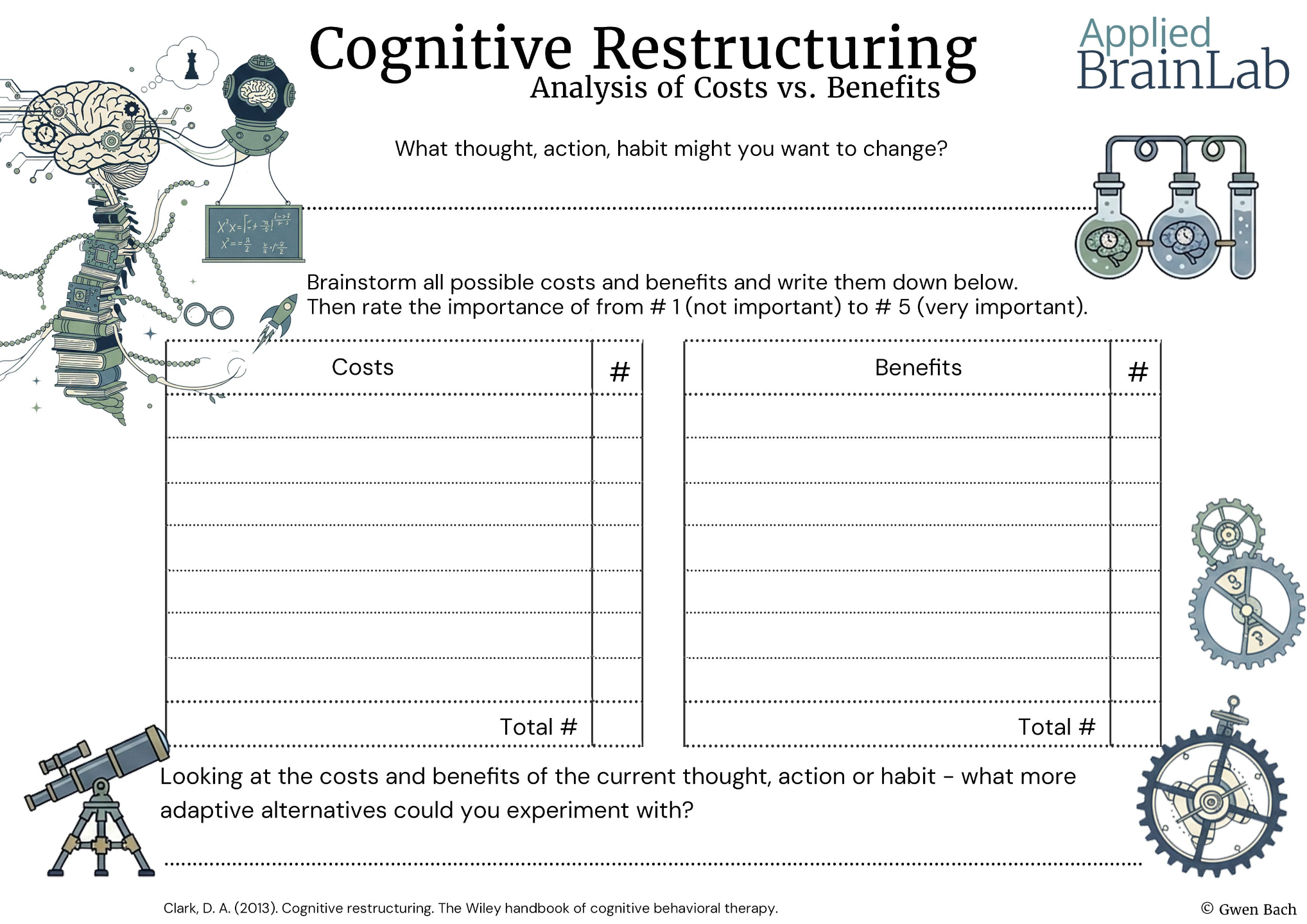
Cognitive Restructure Worksheet
A tool for restoring decision structure when working memory is saturated
For senior professionals and decision-makers who find themselves stuck in repetitive reasoning under pressure, this tool helps externalise decision variables and reduce cognitive load.
What this tool is for:
This worksheet is designed for moments when decision-making becomes rigid under pressure.
When working memory capacity is reduced, complex decisions tend to collapse. Variables drop out of consideration, alternatives narrow prematurely, and reasoning begins to loop. The issue is not intelligence, expertise, or effort. It is a capacity limitation.
The Cognitive Restructure Worksheet helps by externalising the decision model.
Instead of holding competing variables, constraints, and assumptions in working memory, the worksheet moves them into structure. This reduces cognitive load and allows the system to work with the full decision space again.
Use case
You are in a decision review meeting. Multiple experts present conflicting inputs. You know the decision involves several interacting variables, but in the moment your thinking collapses to one metric.
You repeat the same argument, slightly rephrased. New information arrives but does not integrate. The model feels thinner with each round, not clearer.
This pattern is a marker of working memory saturation.
The worksheet is designed for exactly this moment.

When this tool is appropriate
This worksheet is not a general planning aid.
It is intended for specific failure modes.
Use it when you notice signs of cognitive rigidity such as:
-
repeating the same line of reasoning without reaching a new synthesis
-
difficulty holding multiple alternatives in mind simultaneously
-
fixation on a single metric or constraint despite evidence of complexity
-
inability to clearly articulate why certain options were dismissed
-
a sense that the decision model is thinning rather than resolving
These markers indicate that working memory is operating at or beyond capacity. More effort usually increases friction. Structural support is the appropriate response.
What the worksheet helps you do
The worksheet is designed to perform a small number of precise functions:
-
Externalise variables that repeatedly drop out of consideration
-
Lay constraints side-by-side, rather than cycling through them sequentially
-
Make assumptions explicit, instead of letting them operate implicitly
-
Reconstruct alternatives that collapsed under load
-
Convert loops into comparisons, enabling forward movement
It does not improve thinking quality in general.
It reduces the cognitive load required to think at all.

How to use it
The worksheet is most effective when used at the moment rigidity is recognised, not before.
Typical use cases include:
-
high-stakes decisions with multiple stakeholders
-
situations where new information arrives but fails to integrate
-
decisions that feel “busy” but are not progressing
-
repeated revisiting of the same arguments with minor variation
Complete the worksheet once per decision point. Over-use adds unnecessary structure and can slow decision-making when working memory is not constrained.

Why this works
Just a brief scientific context.
Working memory is a capacity-limited system. Under stress, that capacity is reduced and cognitive resources are reallocated toward threat detection and rapid response. This makes it harder to maintain, compare, and update multiple representations simultaneously.
Research across cognitive neuroscience and clinical psychology shows that externalising cognitive content reduces working memory load and supports more adaptive processing when internal capacity is constrained. Techniques that surface assumptions, clarify appraisals, and restructure decision representations are associated with reduced perseveration and improved flexibility across contexts.
This worksheet applies those principles to decision structure, not symptom management.
References - optional reading
The underlying principles of this tool are supported by a large body of research on cognitive restructuring, appraisal processes, and working memory under load, including:
Carl, J. R., Soskin, D. P., Kerns, C., & Barlow, D. H. (2013). Positive emotion regulation in emotional disorders: A theoretical review. Clinical Psychology Review, 33(3), 343–360. https://doi.org/10.1016/j.cpr.2013.01.003
Jones, C. A., Motl, R. W., & Sandroff, B. M. (2021). Depression in multiple sclerosis: Is one approach for its management enough? Multiple Sclerosis and Related Disorders, 51, 102904. https://doi.org/10.1016/j.msard.2021.102904
Yoon, K. L., Shaffer, V. A., & Benedict, A. (2020). Resolving ambiguity: Negative interpretation biases. In Cognitive biases in health and psychiatric disorders. Elsevier. https://doi.org/10.1016/B978-0-12-816660-4.00006-4
Morales, C., Luks, K., & Sibrava, N. J. (2023). Cognitive-behavioral therapy. In Encyclopedia of Mental Health (2nd ed.). Elsevier. https://doi.org/10.1016/B978-0-323-91497-0.00206-X
This tool is part of Applied Brain Lab’s work on decision-making under pressure.
For a deeper explanation of why working memory narrows under stress and how rigidity emerges, see:
Why stress narrows thinking and leads to rigid decisions